The STAR Method Interview Guide (With Story Examples)
How to use the STAR method in an interview so your answers sound like real stories, with timing for each part, five worked examples and a story bank plan.
The STAR method is a way to answer “Tell me about a time…” interview questions in four parts: Situation, Task, Action, Result. Spend a sentence or two setting the scene, one sentence on what you had to do, most of your time on what you actually did, and finish with what changed. Below you’ll find timing for each part, five full examples, and how to build a bank of stories so you’re never caught empty.
What is the STAR method?
The STAR method is a structure for answering behavioral interview questions: describe the Situation, the Task you were responsible for, the Action you took, and the Result. Interviewers use it because past behavior is the best evidence they have of future behavior, and STAR keeps your answer specific, short and about you.
When an interviewer asks “Tell me about a time you handled a difficult customer,” they aren’t testing whether you’ve met a difficult customer. Everyone has. They’re listening for three things:
- Did it really happen? Specific details (a name, a number, a day of the week) signal a true story.
- What did you do? Not your team, not your manager. You.
- Did you learn anything? The best answers end with a result and a short reflection.
Situation, Task, Action, Result: how much time each gets
Most STAR answers should run about 90 seconds to two minutes. The most common mistake is spending a minute on the situation and racing through the action. Here’s a split that works:
| Part | Share of the answer | What to say | Example line |
|---|---|---|---|
| Situation | About 15% | Where, when, what was going on | “Two weeks before our biggest product launch…” |
| Task | About 10% | What you were responsible for | “I owned the customer email list.” |
| Action | About 60% | The steps you took, in order | “First I called the vendor, then I…” |
| Result | About 15% | What changed, with a number if true | “We hit the date and complaints dropped.” |
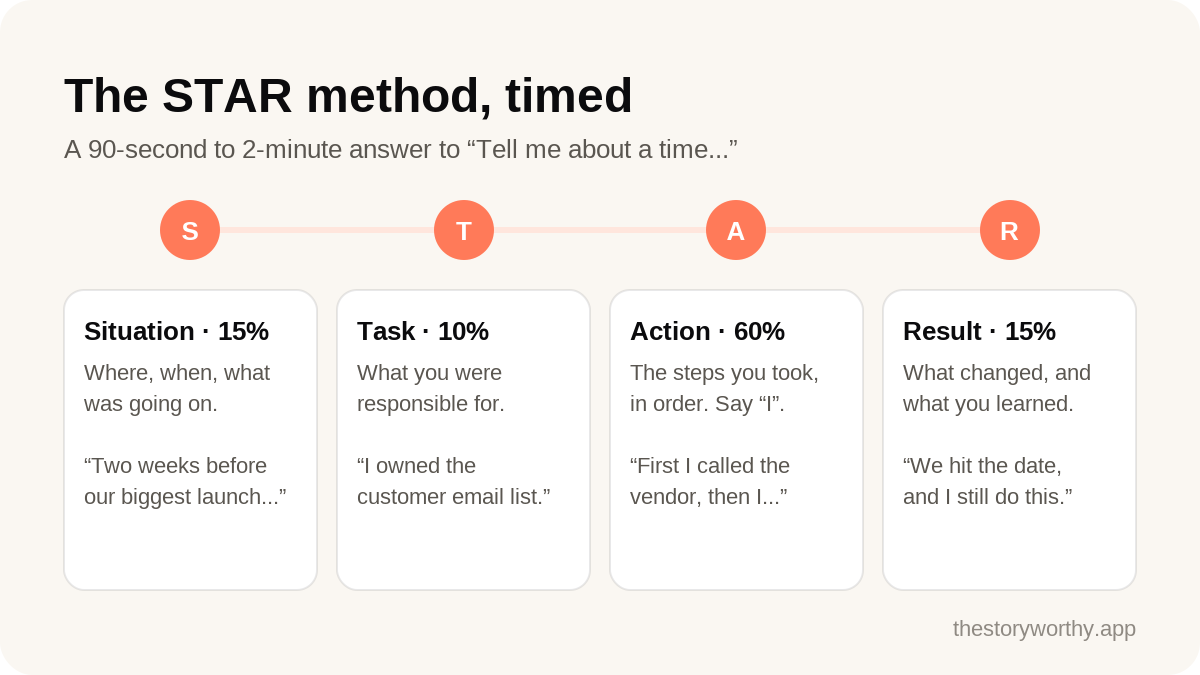
A good rule: if you’ve talked for 30 seconds and haven’t said “I” followed by a verb, you’re still in the setup.
Five STAR method examples, start to finish
These are written the way you’d say them, not the way you’d write them on a resume. Swap in your own details.
1. “Tell me about a time you dealt with a difficult customer.”
Situation: “I was working the front desk at a dental office, and a patient came in furious because his insurance had been billed twice.”
Task: “Billing wasn’t my job, but I was the person in front of him, and he was about to walk out.”
Action: “I asked him to sit down and walked him through his statement line by line so he could see I was taking it seriously. I called our billing contact while he waited, found the duplicate charge, and got a reversal started. Then I wrote my cell number on a sticky note and told him I’d call him Friday either way.”
Result: “The refund went through Thursday. I called him Friday anyway. He’s still a patient, and the office started using my ‘call them by Friday’ habit for every billing complaint.”
2. “Tell me about a time you had a conflict with a coworker.”
Situation: “On a marketing team, a designer and I kept missing each other’s deadlines, and it was getting tense in meetings.”
Task: “We had a campaign due in three weeks that needed both of us.”
Action: “I asked her to grab coffee, just us. I opened by saying I thought I was part of the problem. It turned out my briefs were landing on her desk late Friday, which wrecked her week. We agreed I’d send drafts by Wednesday and she’d flag anything unclear the same day.”
Result: “The campaign shipped on time. More important, we worked together for two more years without that tension again.”
3. “Tell me about a time you failed.”
Situation: “In my first manager role, I promised a client a feature by the end of the quarter.”
Task: “I was responsible for the estimate and the timeline.”
Action: “I didn’t check with the engineers before committing. When they told me it would take twice as long, I went back to the client myself, explained that I’d overpromised, and offered a smaller version by the original date.”
Result: “They took the smaller version, and we kept the account. Since then I don’t give a date until the person doing the work has seen it.” (For more on this one, see tell me about a time you failed.)
4. “Tell me about a time you took initiative.”
Situation: “At a grocery chain, new hires kept quitting in their first month.”
Task: “I was a shift lead with no official role in training.”
Action: “I started spending ten minutes with each new hire at the end of their first three shifts, asking what had confused them. I wrote the answers into a one-page cheat sheet and asked my manager if we could hand it out on day one.”
Result: “My manager added it to onboarding for the store, and I was asked to help with training the next season.”
5. “Tell me about a time you worked under pressure.”
Situation: “I was a nurse on a night shift when two staff called out sick.”
Task: “I was charge nurse and had to keep the floor safe with fewer people.”
Action: “I re-sorted assignments by patient need, not by room number, called the house supervisor for a float nurse, and took two patients myself so nobody had more than they could handle.”
Result: “We got through the night with no incidents. The supervisor asked me to write up how I’d split the assignments for other charge nurses.”
Why most STAR answers sound robotic
People learn the acronym and then recite it like a form: “The situation was… The task was… The action I took was…” Interviewers hear that all day.
The fix is to tell it like a story, the way you would to a friend:
- Open with a moment, not a label. “Two weeks before launch, our vendor went silent” beats “The situation was a vendor issue.”
- Use one real detail. A sticky note, a Friday, a phone call. Details make it believable.
- Let the action have steps. “First… then… and when that didn’t work…” shows thinking.
- Say what you felt, briefly. “I was nervous, because it wasn’t my call to make” makes you human.
- End with what you’d keep doing. A one-line lesson ties it to the job you want.
If you want to go further with this, the techniques in how to tell a story apply directly to interview answers.
Build a bank of 8 stories before the interview
You don’t need a different story for every question. Eight good ones cover most of what you’ll be asked, because each story can answer several questions. Here’s how to build the bank:
- List your last three roles or projects. Include school, volunteering and side work if you’re early in your career.
- Write one moment per category. Conflict, failure, leadership, initiative, pressure, a difficult person, a win you’re proud of, a time you changed your mind.
- Give each story a short title. “The double-billed patient.” “The Wednesday briefs.” Titles make them easy to recall under stress.
- Note the result in one line. If there’s an honest number, include it. If not, say what changed.
- Map each story to two or three questions. “The Wednesday briefs” answers conflict, communication and teamwork.
- Say each one out loud once. You’ll find the slow parts immediately.
- Cut each to two minutes. Then cut again to see if 90 seconds still works.
For a long list of the questions these stories need to answer, see behavioral interview questions. And since the first question is usually tell me about yourself, have one story ready to drop into that answer too.
Practice out loud, then cut
Writing your STAR answers is a start, but interviews are spoken. The answer that reads well on paper often runs three minutes out loud.
Record yourself answering one question on your phone. Play it back and listen for:
- Long setup. If the action starts after 40 seconds, trim the situation.
- “We” instead of “I.” Keep the team in the story, but make your part clear.
- A missing result. If it trails off, add one sentence on what changed.
- Filler. “Basically,” “kind of,” “you know” bunch up when you’re unsure of the next step.
Then do it again tomorrow without notes. By the third time, the story sounds like you, not like a script.
STAR method FAQ
How long should a STAR method answer be?
Aim for 90 seconds to two minutes. That’s long enough to show your actions in steps and short enough that the interviewer can ask a follow-up. If you go past three minutes, the situation is almost always too long. Trim the backstory and keep the action.
Can I use the same story for more than one question?
Yes, and you should. A good story about a conflict with a coworker can also answer questions about communication or teamwork. Just change which part you emphasize. Avoid telling the same story twice to the same interviewer in one conversation.
What if I don’t have a work example?
Use school, volunteering, sports, caregiving or a part-time job. Interviewers care about how you behave, not where. A story about organizing a group project or handling an angry customer at a summer job is a valid STAR answer if it’s specific and you’re honest about your role.
What’s the difference between STAR and CAR?
CAR stands for Challenge, Action, Result. It folds the situation and task into one “challenge” step. It’s a shorter version of the same idea, useful when the setup is simple. STAR gives you a separate place to say what you were responsible for, which helps when your role isn’t obvious.
Collect your stories before you need them
The hardest part of STAR isn’t the structure, it’s remembering the moments. Most people sit down the night before an interview and draw a blank. Storyworthy helps with that: you record a short story when something happens at work (or type it), AI tags it by emotion, people and where it can be told, including job interviews, and later you can ask for “a story about handling pressure” and get the right one back.
It’s not in the app stores yet. Join the waiting list to try it at launch.