Behavioral Interview Questions: 25 Examples and Answers
25 common behavioral interview questions grouped by the 6 stories that answer most of them, with sample answers and a plan to build your story bank.
Behavioral interview questions ask you to describe how you handled a real situation in the past, usually starting with “Tell me about a time…” Below are 25 of the most common ones, grouped by the six stories that can answer nearly all of them, with sample answers and a simple plan for building your story bank before the interview.
What are behavioral interview questions?
Behavioral interview questions are questions about specific things you’ve done, such as “Tell me about a time you disagreed with your manager.” Employers ask them because how you handled real situations is better evidence of how you’ll work than hypothetical answers. A strong answer is a short, true story with a clear action and result.
What behavioral questions test
Each behavioral question is aimed at a skill the employer cares about. When you know the skill, you know which story to reach for.
- Teamwork: Can you work with people who aren’t like you?
- Conflict: Can you disagree without damaging the relationship?
- Leadership: Do you step up, even without a title?
- Initiative: Do you see problems and fix them unprompted?
- Failure: Can you own a mistake and learn from it?
- Pressure: Do you stay effective when things go wrong?
Interviewers listen for specifics. “I’m a good communicator” means nothing. “I set up a Wednesday check-in so the designer got my drafts two days earlier” means a lot.
The 6 stories that answer most of them
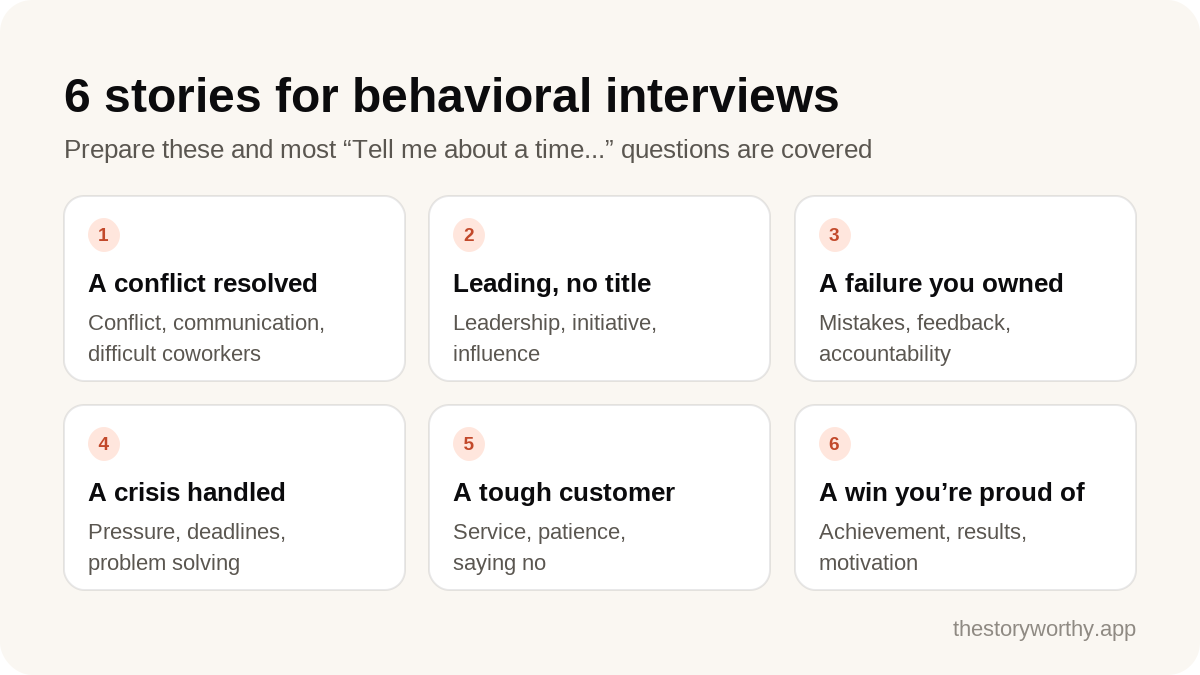
You don’t need 25 separate stories. You need six good ones, each flexible enough to answer several questions.
| Story to prepare | Answers questions about | Example title |
|---|---|---|
| A conflict you resolved | Conflict, communication, difficult people | “The Wednesday briefs” |
| A time you led without authority | Leadership, initiative, influence | “The onboarding cheat sheet” |
| A failure you owned | Failure, mistakes, learning, accountability | “The overpromised feature” |
| A crisis you handled | Pressure, deadlines, problem solving | “The night shift with two call-outs” |
| A difficult customer or stakeholder | Customer service, patience, persuasion | “The double-billed patient” |
| A win you’re proud of | Achievement, results, motivation | “The campaign that beat its goal” |
Teamwork and conflict questions
- Tell me about a time you had a conflict with a coworker.
- Describe a time you disagreed with your manager.
- Tell me about a time you worked with someone whose style was very different from yours.
- Give an example of a time you had to rely on a teammate to get something done.
- Tell me about a time you had to deliver bad news to a colleague.
- Describe a situation where a team you were on wasn’t working well. What did you do?
What they’re looking for: that you go to the person directly, listen, and focus on the work rather than who’s right.
Leadership and initiative questions
- Tell me about a time you took the lead on a project.
- Describe a time you went beyond what was expected.
- Give an example of a process you improved.
- Tell me about a time you persuaded someone to change their mind.
- Describe a time you had to make a decision without all the information.
- Tell me about a time you mentored or trained someone.
- Give an example of a goal you set and how you reached it.
What they’re looking for: that you notice problems, act without being told, and bring people along.
Failure and pressure questions
- Tell me about a time you failed.
- Describe a mistake you made at work and how you handled it.
- Tell me about a time you missed a deadline.
- Give an example of a time you worked under significant pressure.
- Tell me about a time you had too many priorities at once.
- Describe a time when a plan changed at the last minute.
- Tell me about a time you received critical feedback.
What they’re looking for: honesty, ownership and a clear lesson. Never pick a fake failure (“I work too hard”). For a full guide to this one, see tell me about a time you failed.
Customer and achievement questions
- Tell me about a time you dealt with a difficult customer.
- Describe a time you had to say no to a customer or stakeholder.
- Tell me about your proudest professional accomplishment.
- Give an example of a time you exceeded a goal.
- Tell me about a time you had to learn something new quickly.
Sample answers
Each of these follows the STAR method: Situation, Task, Action, Result. They’re written the way you’d say them.
“Tell me about a time you disagreed with your manager.”
“My manager wanted to launch a customer survey in December. I’d run surveys at my last company and knew response rates dropped badly over the holidays. I didn’t want to just say ‘that’s a bad idea,’ so I pulled the response numbers from our last two December emails and showed her the drop. I suggested we launch the second week of January instead. She agreed, and we got enough responses to actually use the results. What I took from it: bring the data, not just the opinion.”
“Tell me about a time you took the lead on a project.”
“Our office had no system for tracking supply orders. People ordered the same things twice, and some things never arrived. Nobody owned it. I asked my manager if I could try fixing it, built a shared order sheet with one column for ‘who’s checking delivery,’ and spent fifteen minutes explaining it at a team meeting. Within a month, duplicate orders basically stopped. I’m not a manager, but I learned that a lot of leadership is just volunteering to own something nobody owns.”
“Tell me about a time you worked under pressure.”
“Two days before a client presentation, the colleague who’d built half the slides got sick. I had my own half to finish. I made a list of what had to be in the deck versus what was nice to have, cut it down by a third, and called the client to confirm the three things they cared about most. I worked late one night and presented both halves. The client signed. I’d normally try to do everything, but that week taught me to cut first and polish second.”
“Tell me about a time you had to learn something new quickly.”
“I joined a team that used a reporting tool I’d never seen, and my first report was due in a week. I spent the first afternoon rebuilding an old report from scratch so I could learn the tool on something where I knew the right answer. Then I asked a teammate for twenty minutes to check my work. I delivered on time, and I’ve since written a short how-to guide for new hires.”
How to prepare your story bank in 6 steps
- List your roles from the last five years. Include volunteering, school or side projects if you’re early in your career.
- Write down one moment for each of the six stories. Don’t polish yet.
- Give each a short title. Titles help you recall them under stress.
- Write each one in STAR form. Two or three sentences per part, action longest.
- Map each story to questions from the list above. Most will cover four or five.
- Say each one out loud, then time it. Aim for 90 seconds to two minutes.
The night before an interview, read your titles, not full answers. You know the stories; the titles just bring them to the front of your mind. The first question will often be tell me about yourself, and one of these stories can go there too.
Behavioral interview questions FAQ
How do I answer behavioral interview questions?
Use a short, true story in the STAR format: the situation, your task, the actions you took, and the result. Spend most of your time on what you did, say “I” rather than “we” for your part, and end with what changed or what you learned. Aim for about two minutes.
How many stories should I prepare for a behavioral interview?
Six to eight well-prepared stories are usually enough. Choose ones that cover conflict, leadership, failure, pressure, a difficult customer and a proud achievement. Each story can answer several questions if you change which part you emphasize.
What if I can’t think of an example?
Ask for a moment to think; that’s normal. If you truly have no direct example, use the closest situation from school, volunteering or personal life, and be honest about it. Avoid answering with a hypothetical “I would…” unless you have no alternative, since interviewers want real experiences.
Can my examples come from outside work?
Yes, especially if you’re early in your career. Group projects, part-time jobs, sports teams, caregiving and volunteering all produce good examples. What matters is that the story shows the skill they’re asking about and that your role in it is clear.
Build your story bank as you go
The best time to collect interview stories isn’t the night before. It’s the day they happen. Storyworthy is a voice journal where you record a work moment in about 30 seconds, and AI tags it by emotion, people and where it can be told, job interviews included. When an interview comes up, ask for “a story about a conflict I resolved” and it comes back, ready to shape.
It’s not in the app stores yet. Join the waiting list.