'Tell Me About a Time You Failed': How to Answer
How to answer "tell me about a time you failed": choose the right failure, tell it honestly in STAR form, land on what changed, with sample answers.
To answer “Tell me about a time you failed,” pick a real failure that mattered but wasn’t a disaster, own your part in it plainly, explain what you did next, and end on what changed in how you work. Keep it to about 90 seconds using the STAR structure, with most of the time spent on what you did and learned. Below: why interviewers ask, how to choose the failure, a structure, sample answers and the failures to avoid.
Why do interviewers ask “tell me about a time you failed”?
Interviewers ask “tell me about a time you failed” to see whether you can take responsibility, learn from mistakes and stay steady under pressure. They want honesty, self-awareness and evidence that you changed something afterward. A candidate who claims never to have failed, or blames others, worries them more than the failure itself.
What they’re listening for:
- Ownership. Do you say “I” for the mistake, not just for the fix?
- Judgment. Did you notice the failure yourself, and how fast?
- Recovery. What did you do once it went wrong?
- Learning. What’s different now, concretely?
- Proportion. Can you talk about a setback calmly, without drama or excuses?
Choosing the right failure
The right story is real, has stakes and has a clear lesson you still use.
Good failures to use:
- A project that missed its deadline because you underestimated it
- A decision you made with incomplete information that turned out wrong
- A time you didn’t speak up and should have
- Taking on too much and dropping something
- A launch, pitch or event that didn’t work as planned
- Feedback you ignored and later realized was right
| Failure | Good choice? | Why |
|---|---|---|
| Missed a deadline by underestimating work | Yes | Common, clear lesson about planning |
| Didn’t raise a problem early | Yes | Shows growth in communication |
| A pitch or launch that flopped | Yes | Stakes are real, recovery is visible |
| “I work too hard” | No | Not a failure; reads as dodging |
| Broke a law or company policy | No | Raises trust concerns |
| A team failure you didn’t cause | No | Doesn’t show ownership |
Also avoid failures that touch a core skill for the job. A candidate for an accounting role shouldn’t lead with a story about getting the numbers wrong in a filing.
Structure: what happened, what you did, what changed
This is the STAR method adapted for failure: situation, task, action, result, plus the lesson.
How to answer “tell me about a time you failed” in 6 steps
- Set the scene briefly. One or two sentences: your role, the project, what was at stake.
- State the failure plainly. “I missed it.” “I got it wrong.” No softening.
- Own your part. Say what you did or didn’t do that caused it.
- Describe the recovery. What you did once you realized: who you told, what you fixed.
- Give the result. What happened in the end, honestly.
- Say what changed. A specific habit or practice you still use, ideally with a later example.
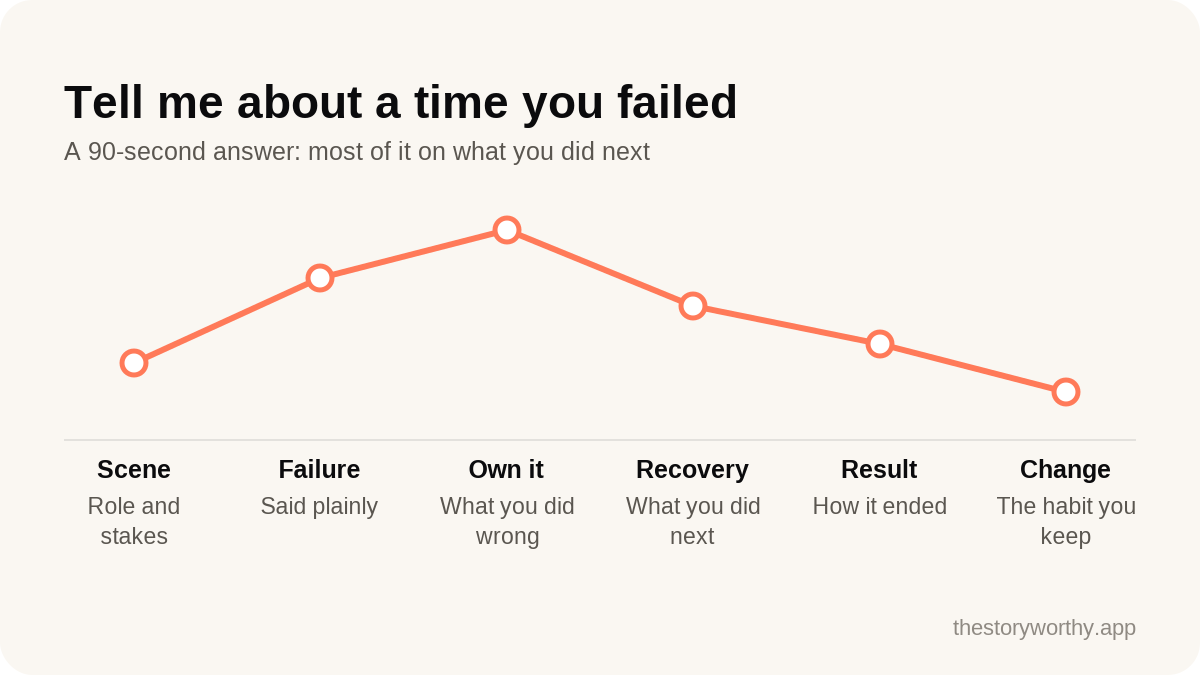
Spend roughly a quarter of your time on the situation and failure, and the rest on action, result and lesson. The interviewer cares most about what you did next.
Sample answers
Adapt these to your own real experiences. Never borrow a story that didn’t happen to you.
Marketing coordinator: missed deadline
“In my first year as a marketing coordinator, I owned the email campaign for our spring sale. I said yes to two other projects that month and assumed I could fit everything in. I couldn’t. The campaign went out two days late, after the sale had started, and we missed the early-bird window.
I told my manager as soon as I knew it would slip, not on the day. I wrote a shorter version we could send immediately and set up a reminder email for the final weekend, which recovered some of the traffic.
What changed is how I take on work. I now write a rough time estimate for everything I accept and check it against my calendar before saying yes. Last quarter I pushed back on a request for the first time and explained why. We moved its deadline, and both projects shipped on time.”
Software engineer: didn’t speak up
“On a previous team, I noticed during code review that a new caching approach could cause stale data for some users. The senior engineer who wrote it seemed confident, so I left a soft comment and approved it. A week after release, customers started seeing old account balances.
I told the team I’d seen the risk and hadn’t pushed hard enough. I helped write the fix and the test that would have caught it.
Since then, if I think something’s wrong, I say so clearly and ask for a quick call instead of leaving a vague comment. It’s led to a few awkward conversations and a few bugs that never shipped.”
Team lead: tell me about a time you overcame a challenge
This related question works with the same structure. Just put more weight on the challenge and less on the mistake.
“When I became team lead, two of my five people resigned in the same month during our busiest season. I had to keep commitments with three people. I listed every open request, met with each client to agree on which could move, and took on some of the work myself. We delivered the two most important projects on time and moved the third by two weeks with the client’s agreement. I learned to say no early and in person, and I now keep a simple priority list the whole team can see.”
Failures to avoid
- The fake failure. “I’m a perfectionist.” Interviewers have heard it and don’t believe it.
- The catastrophe. Something that cost a lot of money or harmed someone, unless you’re asked directly.
- The blame story. If the failure was mostly someone else’s, it isn’t your failure story.
- The ancient story. A failure from high school, unless you’re very early in your career.
- No lesson. If you can’t say what changed, pick a different story.
- The unfinished one. Avoid failures you haven’t recovered from yet.
Rehearse it
Failure stories are easy to ramble through, because they come with feelings. Practice helps.
- Say it out loud and time it. Aim for 90 seconds to two minutes.
- Record yourself. Listen for excuses (“but the brief was unclear…”) and cut them.
- Check your ratio. Is most of the answer about what you did and learned?
- Prepare two stories. One about a task or project, one about people or communication.
- Practice the follow-up. “What would you do differently?” often comes next. Have one clear sentence ready.
The same stories may also answer other behavioral interview questions, such as mistakes, conflict or pressure. And if you’re asked “why should we hire you” later, a different success story makes a nice contrast; see why should we hire you.
Tell me about a time you failed: FAQ
What is a good failure to talk about in an interview?
A real, work-related failure with moderate stakes and a clear lesson: a missed deadline, a wrong call made with incomplete information, a problem you didn’t raise early enough. Avoid failures involving dishonesty, safety or a core skill the job depends on. The best choice shows you owned it and changed something.
How do you answer “what is your greatest failure”?
Treat it like “tell me about a time you failed,” but choose a failure with slightly bigger stakes. Explain the situation briefly, own your part, describe what you did to recover and spend most of the answer on what changed in how you work. “Greatest” doesn’t have to mean disastrous; it means meaningful.
Is it okay to say I’ve never failed?
No. It suggests either a lack of self-awareness or that you’ve never taken risks. Every experienced professional has failed at something. Interviewers want to see how you handle it, so having no answer is a worse sign than a modest, honest failure story.
How long should my failure story be?
Around 90 seconds to two minutes. Keep the setup to a couple of sentences, state the failure plainly and spend most of the time on what you did next and what you learned. If the interviewer wants more detail, they’ll ask follow-up questions.
Keep your work stories while they’re fresh
The best interview stories are the ones you wrote down right after they happened, details included. Storyworthy is a voice journal for that: talk for about 30 seconds after a hard week, and it writes the story down, titles it and tags it for where it can be told, like a job interview. Before your next interview, ask it for “a time I made a mistake at work” and practice the short version.
Storyworthy isn’t in the app stores yet. Join the waiting list.