How to Tell a Story People Remember: A Simple Method
How to tell a story out loud that people remember: start in the middle, set one scene, find the turn and end on the change, with before-and-after examples.
To tell a story people remember, start in the middle of the action, set one clear scene, raise the stakes, show the moment things turned, and end on how you changed. That’s the whole method. The rest of this guide walks through each step with before-and-after examples from dinner tables, first dates and work meetings, plus how to shrink or stretch the same story for different rooms.
How do you tell a good story?
You tell a good story by putting the listener inside one moment and letting them feel it change. Open with action, not background. Give one scene with a few concrete details. Make clear what could go wrong. Slow down at the turn. Finish with what was different afterward, usually something in you. Most great stories are under two minutes.
Here’s the method in seven steps:
- Hook. Open in the middle of something happening.
- Scene. Put us in one place, at one time, with one or two details.
- Stakes. Say what you wanted and what could go wrong.
- Build. Give two or three beats where it gets harder or stranger.
- Turn. Slow down for the moment things changed.
- Change. End on how you, or how you saw things, shifted.
- Stop. Don’t explain the moral. Let the last line land.
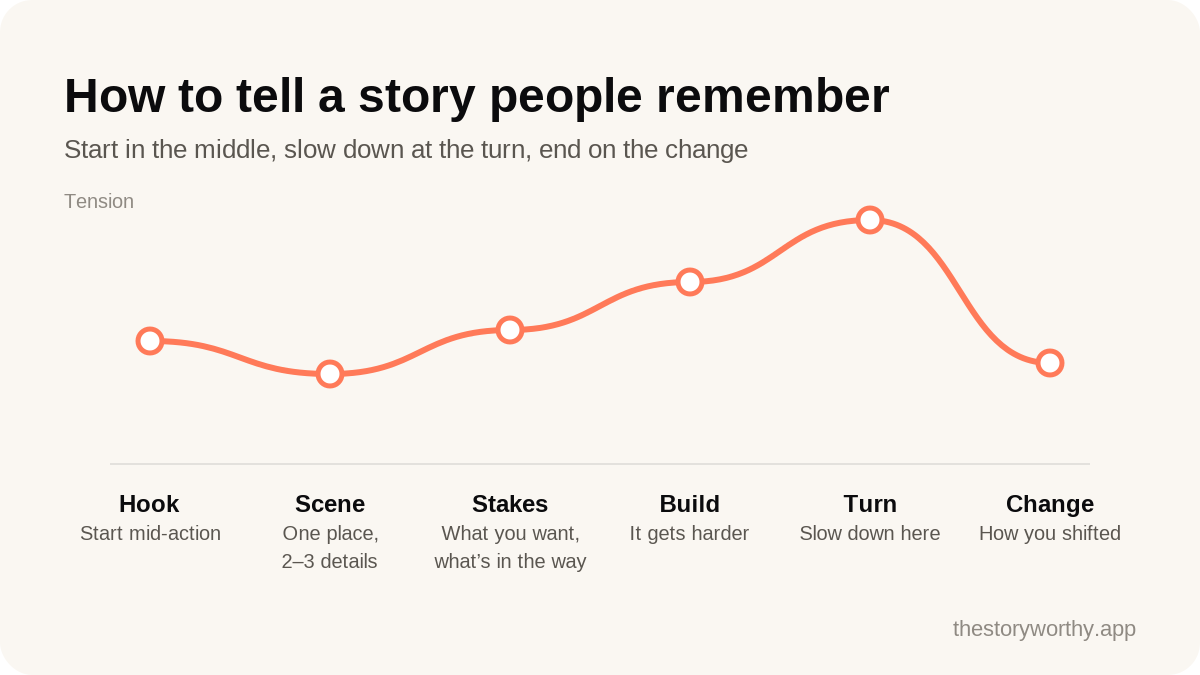
Start in the middle: the hook
Most people start a story at the chronological beginning: “So, I’d been thinking about getting a dog for a while, and my sister had this friend who…” By the time the dog shows up, the table is checking their phones.
Start at the first moment something is happening instead.
Before: “So last summer we decided to go camping, and we’d never really camped before, and my husband found this site online…”
After: “At 2 a.m., in a tent in Vermont, my husband whispered, ‘Don’t move. Something is eating our cooler.’”
The second version gives the listener a question (what’s eating the cooler?) in the first sentence. You can fill in the backstory later in one line if it’s needed. Usually it isn’t.
Good hooks tend to be one of these:
- A line of dialogue. “‘You’re not going to like this,’ my manager said.”
- A time and place with tension. “Twenty minutes before my sister’s wedding, the officiant called in sick.”
- A confession. “I’ve never told my parents what really happened to their car.”
Set one scene, not the whole backstory
A story happens somewhere. Pick one room, one street, one car, and give the listener two or three details so they can see it. Not ten. Two or three.
Before: “It was a networking event.”
After: “It was a networking event in a hotel ballroom with carpet that smelled like old coffee, and I was holding a plate of cheese cubes I didn’t want.”
The cheese cubes do more work than any amount of explanation. They tell us you’re uncomfortable without you saying so.
The backstory you think is essential usually fits in one sentence: “I’d just moved to Denver and didn’t know anyone.” Say that, then go back to the scene.
Find the stakes and the turn
A story without stakes is an anecdote about your day. Stakes don’t need to be life or death. They just need to be clear: what did you want, and what was in the way?
- You wanted the job, and you’d just spilled water on the interviewer’s notes.
- You wanted your dad to approve of your fiancé, and they’d just started talking politics.
- You wanted to get through the presentation, and the projector died.
The turn is the moment the situation changes. Someone says something unexpected, you make a decision, or you suddenly see things differently. It’s the heart of the story, so slow down here. Shorter sentences. A pause before the key line. This is where people lean in.
Act it, don’t summarize it
Summary tells the listener what happened. Acting lets them watch it happen. The fastest way to switch from one to the other is dialogue.
Summary: “My grandmother was really upset that I’d dropped out of college.”
Acted: “My grandmother put down her fork, looked at me for a long time, and said, ‘Well. Somebody in this family had to be interesting.’”
A few techniques that help:
- Use present tense at the peak. “So I’m standing there, and he turns around…” pulls the listener into the moment.
- Do the voices lightly. Not an impression, just a shift in tone so we know who’s talking.
- Show your reaction. A pause, a shrug, a face. Your body is part of the telling.
End on the change in you
Weak stories end with the plot: “…and then we went home.” Strong stories end with what was different afterward.
Weak: “So the cooler was fine and it was a raccoon.”
Strong: “It was a raccoon. It got the hot dogs. And I realized I’d spent the whole night protecting my husband from a raccoon with a flashlight, which is, I think, the most married I’ve ever felt.”
The change doesn’t have to be profound. “I’ve never ordered the special since” is a fine ending. What matters is that something moved.
A useful check: ask yourself, “Why am I telling this?” If you can’t finish the sentence “This is a story about the time I realized…”, the story may not have an ending yet.
Short, funny or heartfelt: one story, three versions
The same story should flex depending on the room. Here’s the camping story in three shapes:
| Version | Length | What to keep | Where it works |
|---|---|---|---|
| Short | 30 seconds | Hook, turn, one-line ending | Work small talk, a first date |
| Funny | 1 minute | Hook, the flashlight standoff, the raccoon reveal | Dinner parties, a toast |
| Heartfelt | 2 minutes | The scene, the fear, “most married I’ve ever felt” | A wedding speech, an anniversary |
The short version cuts everything except the question and the answer. The funny version spends its time on the build, the escalating absurdity. The heartfelt version slows down on the feeling and lets the ending breathe. Same facts, different emphasis.
If you want to see more stories broken into their parts, read these storytelling examples and anecdote examples.
Practice on small audiences first
Nobody tells a story well the first time. The first telling is a draft, and the people listening are your editors whether they know it or not.
- Tell it to one person. A friend, a partner, a coworker at lunch. Watch where they lean in and where they drift.
- Tell it again a few days later. You’ll naturally cut what didn’t land.
- Say it out loud alone. Record yourself on your phone. Listen once. It’s uncomfortable and it works.
- Time it. Most everyday stories are better under two minutes.
The other half of storytelling is having stories to tell. Many good storytellers keep a daily log of small moments so they have material when they need it. Matthew Dicks calls this practice Homework for Life in his book Storyworthy. If you want the bigger picture of what makes someone good at this, see how to be a good storyteller.
How to tell a story FAQ
What are the 5 parts of a story?
A common breakdown is hook, setup, rising action, turn (or climax) and resolution. For a spoken personal story, think of it as: start in the middle, set one scene, raise the stakes, show the turn, end on the change. The labels matter less than having a moment where something shifts.
How long should a personal story be?
Most everyday stories work best between 30 seconds and two minutes. At a dinner table or on a date, shorter is almost always better. A story in a speech can run a little longer, up to about three minutes, if the build is earning its time.
How do I make a boring story interesting?
Start closer to the turn, cut the backstory to one sentence, add one specific detail and one line of dialogue, and end on what changed for you. Most “boring” stories aren’t boring events, they’re good events told in order from the beginning.
How can I get better at telling stories?
Tell more of them, out loud, to small audiences, and pay attention to where people lean in. Keep a running list of moments from your week so you have material, and retell your best stories a few times until they find their shape.
Practice your stories with Storyworthy
Storyworthy is built for both halves of this: finding stories and telling them. You record a short story from your day in about 30 seconds (or type it), and for any story it writes a telling guide with the hook, the scene, the beats with their tension and how to act them, the twist, and a version for each telling style, like short, funny or heartfelt. An arc drawing shows the ups and downs.
It’s not in the app stores yet. Join the waiting list to be first in line.