How to Answer 'Tell Me About Yourself' in an Interview
How to answer tell me about yourself in an interview: a 90-second present-past-future formula with one short story, plus sample answers for three situations.
To answer “Tell me about yourself” in an interview, give a 60 to 90 second answer in three parts: what you do now, what you did before that led you here, and why you want this role next. Add one short, specific story in the middle so it sounds like you rather than your resume. Below is the formula, how to pick the story, and sample answers for a career changer, a new grad and an experienced hire.
What is the interviewer really asking?
When an interviewer says “Tell me about yourself,” they’re asking for a short professional summary that explains why you’re in the room. They want to hear what you do, what you’re good at, and why this job makes sense as your next step. It’s also a test of whether you can be concise and pick what matters.
It’s rarely a request for your life story, and it’s not a cue to read your resume aloud. They have your resume. What they don’t have is your voice, your priorities and a sense of what you’d be like to work with. That’s what the answer is for.
Behind the question, most interviewers are listening for:
- Relevance. Does what you say connect to this role?
- Clarity. Can you summarize yourself without rambling?
- Energy. Do you sound interested in this job specifically?
- A thread. Does your career make sense as a story, even if it took turns?
Present, past, future: the 90-second formula
| Part | Time | What to say | Example |
|---|---|---|---|
| Present | 20–30 seconds | Your current role and what you’re known for | “I’m a project coordinator at a mid-size construction firm, where I keep three job sites on schedule.” |
| Past | 30–40 seconds | How you got here, plus one short story | “I started on a site crew, and one week…” |
| Future | 15–20 seconds | Why this role, why now | “I’m looking for a role where I can run projects end to end, which is why this one caught my eye.” |
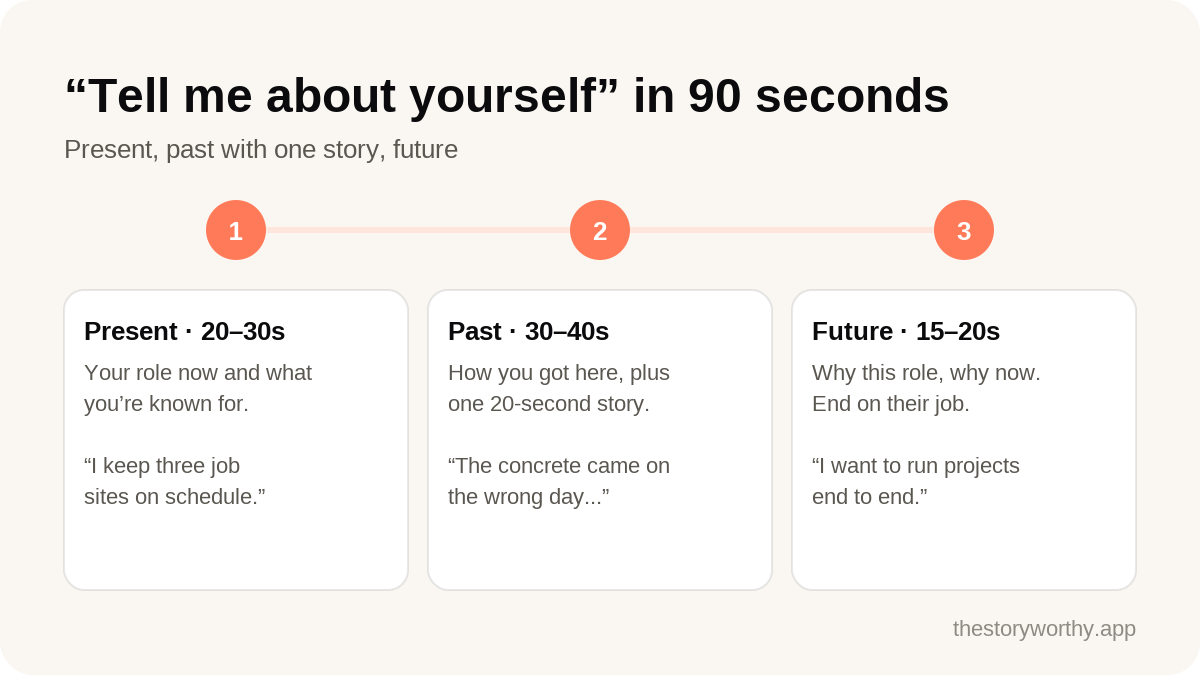
Start in the present, not at the beginning. “I grew up in Ohio and always loved…” is the opening that turns a 90-second answer into five minutes. Present first gives the interviewer an anchor; the past then explains it, and the future points at their job.
Add one story that proves it
Most “Tell me about yourself” answers are a list of claims: “I’m detail-oriented, a team player, and passionate about customer experience.” Every candidate says those words. A story makes one of them true.
Pick a moment, 15 to 20 seconds long, that shows the quality most relevant to the job. It goes in the “past” section.
Claim: “I’m good at keeping projects on track.”
Story: “On my first job site, the concrete delivery was booked for the wrong day, and nobody caught it until the trucks didn’t show. I spent the afternoon calling suppliers and found one who could pour the next morning. That’s when my boss asked if I wanted to move into coordination.”
That’s 20 seconds, and it proves the claim better than any adjective. It also gives the interviewer something to ask about, which is exactly what you want.
How to find your story:
- Name the one quality this job needs most. Read the job posting; it’s usually obvious.
- Think of a moment that proves it. A specific day, problem and person.
- Cut it to three sentences. What went wrong, what you did, what changed.
- Place it as the bridge between your past and your present.
If you’ve built a set of STAR method stories, one of them can usually be shortened to fit here.
Sample answers for three situations
Career changer
“I’m currently a high school chemistry teacher, and for the last two years I’ve also been building the data dashboards our district uses to track student progress. That started almost by accident: our principal asked if anyone could make sense of a spreadsheet nobody understood, and I spent a weekend turning it into something teachers could actually use. Three schools adopted it within a semester. I realized the part of my job I looked forward to most was the data work. I’ve since finished a certificate in data analytics, and I’m looking for a role where I can do that full time, ideally in education, which is why your team stood out to me.”
New graduate
“I just graduated with a degree in communications from Ohio State. The experience that shaped me most was running social media for the campus food bank. When I started, we were posting once a month. I set up a simple schedule, started featuring student volunteers, and by spring we had people showing up because they’d seen a friend in a post. I loved seeing a message turn into people walking through the door. I’m looking for an entry-level marketing role where I can learn from a strong team, and your company’s community work is a big part of why I applied.”
Experienced hire
“I’m a senior product manager with about ten years in B2B software, most recently leading our billing product. What I’ve become known for is getting teams unstuck. Last year we had a launch slip twice; I sat down with engineering and support for a day, found that we were trying to ship four features nobody had asked for, and cut the scope in half. We launched six weeks later and the support tickets dropped. I’m looking for a role with a bigger scope where that kind of judgment matters from the start, which is what drew me to this position.”
Mistakes: the resume recap and the life story
The two most common failures are opposites.
The resume recap. “I graduated in 2016, then I worked at Acme for two years as an analyst, then I moved to Beta Corp as a senior analyst, then…” It’s accurate, it’s long, and nobody remembers it.
The life story. “So I grew up in a small town, and my dad was a mechanic, and I think that’s really where I first got interested in how things work…” Interesting at a dinner party, but the interviewer is waiting for you to get to the job.
Other things to avoid:
- Personal details that don’t connect to the role. Hobbies are fine only if they say something relevant.
- Negativity about a current or past employer. “I’m looking for more growth” is fine; “My boss is impossible” isn’t.
- Ending vaguely. “…and yeah, that’s me.” End on why you want this job.
- Going past two minutes. If they want more, they’ll ask.
Practice it out loud until it’s natural
You’ll say this answer more than any other in your job search, so it’s worth rehearsing properly.
- Write it once. Present, past with story, future.
- Say it out loud and time it. Most first drafts run over two minutes.
- Cut until it’s under 90 seconds.
- Record it on your phone. Listen for filler and where you sound unsure.
- Say it without notes three days in a row. It’ll stop sounding memorized and start sounding like you.
- Adjust the future part for each company. The present and past stay the same.
Expect follow-ups. If your story mentions a problem you solved, the interviewer may ask about it, so know the details. The next questions are often behavioral interview questions or why should we hire you, and the same stories will help there.
Tell me about yourself FAQ
How long should my answer to “Tell me about yourself” be?
Sixty to ninety seconds. That’s enough to cover what you do now, how you got here with one short story, and why you want this role. If you’re over two minutes, you’re probably reciting your resume or starting too far back in the past.
Should I talk about personal life when asked to tell about myself?
Mostly no. Keep the focus professional. A personal detail can work if it connects to the role or shows a relevant quality, like coaching a youth team for a leadership role. Family, health and other private topics don’t belong in this answer.
How do I answer “Tell me about yourself” with no experience?
Use school, internships, volunteering, part-time jobs or projects. The formula still works: what you’re doing now (graduating, finishing a project), one story that shows a useful quality, and why this role is the right next step. Interviewers expect less experience from new grads, not less clarity.
Is “Walk me through your resume” the same question?
Close, but it invites a slightly more chronological answer. Still, don’t list every job. Hit the two or three roles that matter most for this position, tell one short story from one of them, and finish with why you’re applying.
Keep your stories ready
The answer to “Tell me about yourself” is only as good as the story inside it, and those stories are easy to forget. Storyworthy is a voice journal where you record moments from work in about 30 seconds, and AI tags each one by emotion, people and where it can be told, including job interviews. Before an interview you can ask for “a story about fixing a problem under pressure” and get the right one back.
It isn’t in the app stores yet. Join the waiting list to try it first.