Why Should We Hire You? Answers That Tell a Story
How to answer "why should we hire you" with a claim, one quick story as proof and a fit to the role, plus sample answers for different jobs and levels.
The strongest answer to “Why should we hire you?” has three parts: a clear claim about what you bring, one short story that proves it, and a line connecting it to what this team needs. It takes about a minute. Most candidates give the claim and stop (“I’m hardworking and a fast learner”), which sounds like everyone else. The story is what makes the interviewer believe you.
What does “why should we hire you” really ask?
“Why should we hire you” asks you to connect your strongest skill to the employer’s most important need, and to prove it. The interviewer wants to know three things: what you’d actually bring, whether there’s evidence for it, and whether you understand the role well enough to see why it matters here.
Underneath, the question is also checking:
- Confidence. Can you speak plainly about your strengths without bragging or apologizing?
- Research. Do you know what the job needs, or are you giving a generic answer?
- Memorability. Will they remember you after the fifth candidate today?
The last one is where a story wins. People forget adjectives. They remember the time you rebuilt the schedule in a weekend.
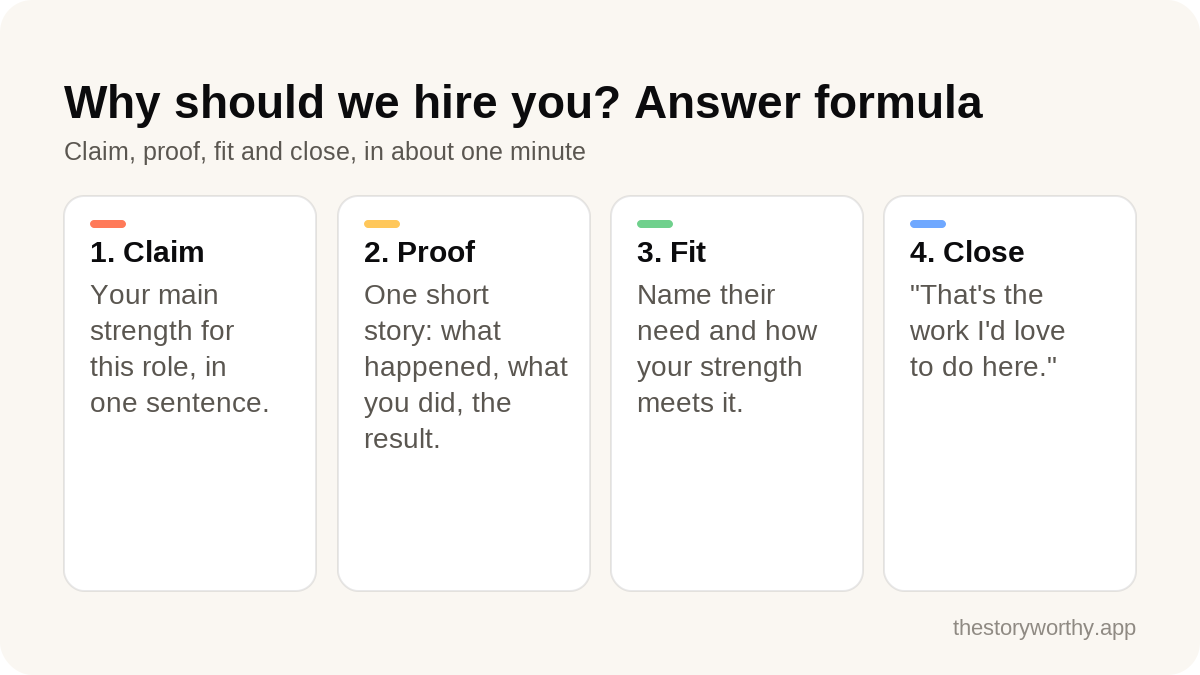
Claim, proof, fit: a simple formula
| Part | What it does | Example |
|---|---|---|
| Claim | States your main strength for this role | “I’m good at turning messy processes into simple ones.” |
| Proof | One short story showing it | “At my last job, onboarding took three weeks. I…” |
| Fit | Links it to their need | “You mentioned you’re scaling the support team…” |
| Close | Shows you want it | “That’s the work I’d love to do here.” |
How to answer “why should we hire you” in 5 steps
- Reread the job post. Circle the two or three needs that appear most or come first.
- Pick one strength that matches. Not five. One, said clearly.
- Choose a story that proves it. A specific time, with a result you can describe.
- Tell it in four sentences. Situation, what you did, what happened, what it shows.
- Bridge to them. Name their need and say how your strength meets it.
Use a story as the proof
The proof is a mini STAR answer: situation, task, action, result, squeezed to about 30 seconds. It should be:
- Specific. A real project, a real customer, a real number you can stand behind.
- Recent if possible. The last two or three years carry more weight.
- About you. Say “I,” not “we,” for the part you did.
- Relevant. It proves the strength you claimed, not a different one.
If you’ve already prepared stories for behavioral interview questions, you have most of what you need. Pick the one that fits this employer’s biggest need.
Sample answers
Change the details to your own. Never use a story that didn’t happen.
Customer support specialist (early career)
“You need someone who stays calm with frustrated customers, and that’s where I’m strongest. At the bookstore where I worked last year, a customer came in furious because a special order had been lost twice. I apologized, called the distributor while she waited, found the book at another branch and drove it to her house on my way home. She’s been a regular ever since. You mentioned your support team handles a lot of escalations, and I’d bring that same patience and follow-through here.”
Project manager (mid-level)
“I make messy projects predictable. In my last role, our website relaunch was two months behind with no clear owner for half the tasks. I mapped every open item, set up a weekly 20-minute check-in and gave each task one name. We launched six weeks later. You’re running several launches at once next year, and keeping multiple teams moving in the same direction is exactly what I like doing.”
Software engineer (senior)
“I’m strongest at finding the real cause of problems other people have worked around. At my current company, our checkout failed for a small share of users and the team had added retries for a year. I spent two days tracing it to a timezone bug in session handling, fixed it and wrote the test that would have caught it. Your post mentions reliability as a priority for the platform team, and that kind of patient digging is what I’d bring.”
Career changer (teacher to instructional designer)
“I’ve spent eight years making hard ideas simple for people who didn’t ask to learn them, which is most of what instructional design is. When our school moved online, I rebuilt my chemistry course into short videos and quizzes in two weeks, and other teachers started using my templates. You’re building onboarding for thousands of new hires, and I know how to keep learners from tuning out.”
Recent graduate with little experience
“You need someone who learns quickly and doesn’t wait to be told. For my final-year project, our team’s data source shut down a month before the deadline. I found a public dataset, taught myself enough SQL in a weekend to clean it, and we finished on time. I’m new to the industry, but I’d bring that same habit of figuring things out.”
Mistakes that hurt
- Listing adjectives. “Hardworking, passionate, team player.” Every candidate says it.
- Comparing yourself to others. “I’m better than the other candidates.” You haven’t met them.
- Talking only about what you want. “This job would be great for my career.” True, but it answers a different question.
- Going too long. Past 90 seconds, you lose them. Aim for about one minute.
- Picking a story that doesn’t match the claim. If you claim leadership, the story should show you leading.
- Sounding rehearsed word for word. Know the shape, not a script.
Practice it
Say your answer out loud, not in your head. Record it on your phone and listen back:
- Does the claim come in the first sentence?
- Is the story specific enough to picture?
- Does the last line mention their need?
- Is it under 90 seconds?
Then practice a second version with a different story. Interviews shift, and having two options lets you choose based on what the interviewer emphasized. This answer also overlaps with tell me about yourself; make sure the two use different stories.
Why should we hire you: FAQ
How long should my answer to “why should we hire you” be?
About 60 seconds, and no more than 90. That’s enough for a one-sentence claim, a short story as proof and a closing line tying it to the role. If the interviewer wants more, they’ll ask a follow-up, which is a good sign that your story caught their interest.
What if I don’t have much experience?
Use stories from school, volunteering, part-time jobs, sports or personal projects. The interviewer is looking for evidence of a trait, like learning fast or taking initiative, not years in the industry. Be honest that you’re early in your career, then show the trait with a specific moment.
Should I mention salary or benefits in my answer?
No. This question is about what you’d bring to them. Talking about what you want from the job makes the answer about you. Save salary and benefits for when the interviewer raises them or for later stages of the process.
Is “why should we hire you” the same as “what makes you unique”?
They’re close. “What makes you unique” leans toward a combination of skills or background no one else has, while “why should we hire you” focuses on fit with this role. The same formula works for both: claim, story as proof, connection to their needs.
Have your proof stories ready
Storyworthy is a voice journal for the stories of your life, including the ones that win interviews. Talk for about 30 seconds after a good day at work and it writes the story down, titles it and tags it for where it can be told, like a job interview. Before your next interview, ask it for “a story about solving a problem under pressure,” and practice the short version from its telling guide.
It isn’t in the app stores yet. Join the waiting list.