Anecdote Examples: Short Stories for Speeches and Talk
Anecdote examples for speeches, interviews and conversation, what an anecdote is, and how to build your own from everyday moments in under a minute.
An anecdote is a short, true story about something that happened, told to make a point or get a laugh. Below are original anecdote examples you can model for speeches, job interviews and everyday conversation, followed by a simple way to find and shape your own. Every example runs well under a minute, which is the whole trick.
What is an anecdote?
An anecdote is a brief, true account of a single incident, usually personal, told in conversation or a speech to illustrate a point, reveal character or entertain. Unlike a full story, an anecdote focuses on one moment, has a quick setup and a clear payoff, and typically takes under a minute to tell.
Three things make an anecdote work:
- It’s real. It happened to you or someone you know well.
- It’s one moment. Not a trip, a year or a career. One afternoon, one conversation.
- It lands somewhere. A laugh, a surprise, or a point you can say in one sentence.
Anecdotes differ from jokes (which are invented and built for a punchline) and from examples (which are general: “many customers struggle with this”). An anecdote says: here’s a specific time it happened.
Anecdote examples for speeches
These short anecdotes for speeches each open or support a point. Notice how fast they get to the moment.
On preparation (work talk):
“The night before my first big client pitch, I practiced in front of my cat for two hours. The next morning the projector died in the first minute. I gave the whole pitch from memory, and we won the account. The cat deserves some credit. Mostly, it taught me that you prepare for the thing you can’t control by knowing the thing you can.”
On kindness (graduation or community talk):
“My first week at college, I locked myself out of my dorm in a towel. A guy from down the hall I’d never spoken to gave me his sweatpants, walked me to the front desk, and waited. He’s been my closest friend for eleven years. Most of the best things in my life started with someone being kind for no reason.”
On a couple (wedding toast):
“The first time Sam cooked for Priya, he set off the smoke alarm twice. She ate everything anyway and asked for seconds. I knew then she was either very polite or very in love. Turns out it was both.”
For the full speech side of this, see public speaking tips.
Anecdote examples for interviews
In interviews, an anecdote is proof. The claim is “I’m good under pressure”; the anecdote shows it.
Problem solving:
“Two days before a product launch, our payment provider changed their API. I stayed late with one engineer, we split the docs in half, and had a fix tested by morning. We launched on time. What I took from it is that the fastest way through a crisis is to divide it up early.”
Handling a mistake:
“In my first month as an analyst, I sent a report to the whole department with last year’s numbers. I emailed a correction within the hour, explained exactly what went wrong, and built a checklist I still use. My manager later told me the correction was what she remembered, not the mistake.”
Customer focus:
“A regular at the café where I worked always ordered the same oat latte. One day he looked rough, so I asked if he was okay. His dog had died. The next week he brought me a photo of her. That’s when I understood that service is mostly noticing.”
These follow the shape of the STAR method: situation, task, action, result, compressed into a few sentences.
Anecdote examples for conversation
In conversation, anecdotes are what you give back after someone shares. They should be short, a bit funny or warm, and easy to respond to.
Travel:
“I once took the wrong train in Italy and ended up in a town having its once-a-year festival. Someone handed me a plate of pasta and I stayed until midnight.”
Family:
“My grandfather had one rule at dinner: you could only complain if you also told a joke. Our dinners were very loud.”
Small daily moment:
“This morning a kid on the bus asked his mom why the moon was out in the daytime, and she said, ‘It’s working overtime.’ He nodded like that made total sense.”
| Setting | Goal | Length | Example opener |
|---|---|---|---|
| Speech opening | Grab attention, set up the point | 30–60 sec | “The night before my first pitch…” |
| Wedding toast | Show the couple, get a warm laugh | 30–45 sec | “The first time Sam cooked for Priya…” |
| Job interview | Prove a skill | 45–90 sec | “Two days before launch…” |
| Conversation | Give something back | 15–30 sec | “I once took the wrong train…” |
| Team meeting | Make a lesson concrete | 20–40 sec | “Last week a customer told me…” |
How to find your own
You already have dozens of anecdotes. You just don’t remember them when you need them. The fix is to start noticing and keeping them.
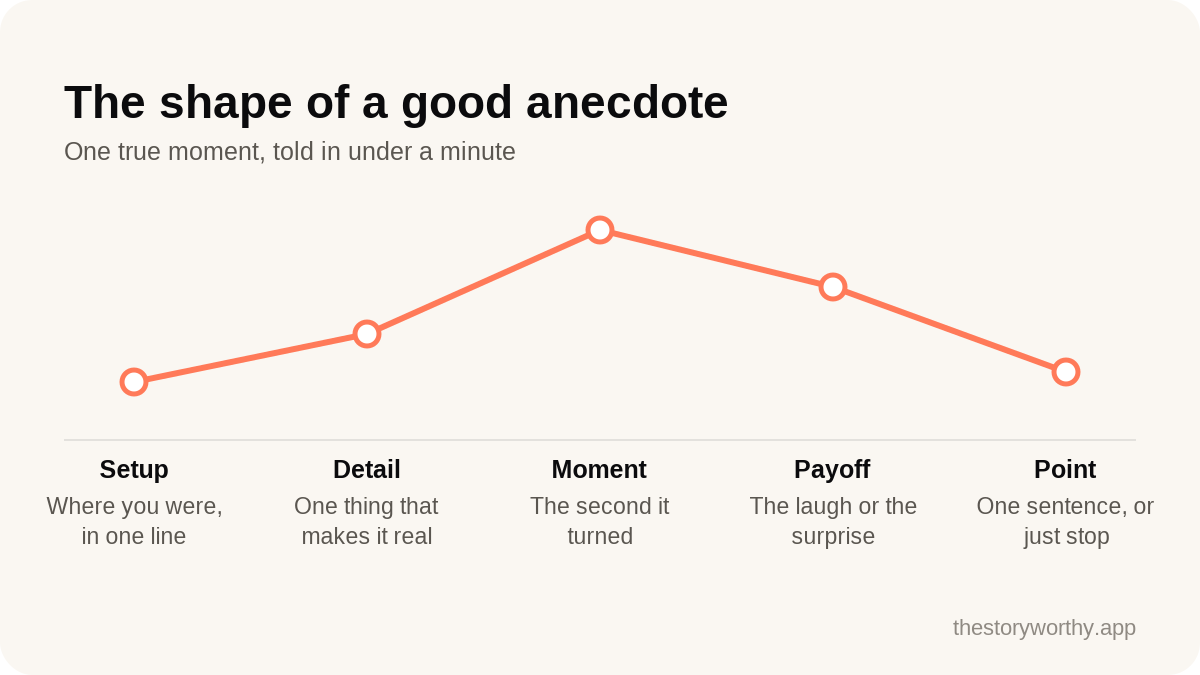
How to tell an anecdote in 6 steps
- Catch the moment. At the end of the day, ask: what’s one small thing that happened that I’d tell a friend?
- Write one line. “Kid on the bus, moon working overtime.” That’s enough to remember it.
- Find the payoff. What’s the line, the gesture or the surprise that makes it worth telling?
- Start close to it. Cut everything before the moment that isn’t needed. “I was on the bus this morning” is plenty.
- Add one real detail. The color of the sweatpants, the name of the town. One detail makes it believable.
- Know your point, or just stop. In a speech, say the point in one sentence. In conversation, stop at the payoff and let people react.
Places to look for anecdotes:
- First days (school, jobs, cities)
- Mistakes that turned out fine
- Strangers who surprised you
- Things kids, grandparents or pets did
- Times you were wrong
- Small wins nobody else saw
For more longer-form ideas, storytelling examples has stories of every size, and how to tell a story covers structure in depth.
Keep it under a minute
Most anecdotes go wrong by getting long. The teller remembers every detail and includes all of them. The audience only needs the ones that lead to the moment.
Quick cuts that work:
- Drop the date hunt. “It was a Tuesday, no, Wednesday…” Nobody cares.
- Drop side characters. If someone doesn’t affect the payoff, leave them out.
- Drop the backstory. Start at the scene, not the reason you were there.
- Drop the explanation after the payoff. If it was funny, they laughed. You don’t need to explain why.
Say it out loud and time it. If it’s over a minute, cut until it isn’t. In a speech, a 40-second anecdote with one clear moment beats a three-minute story every time.
Anecdote examples: FAQ
What is an example of an anecdote?
“The first time I made dinner for my in-laws, I forgot to turn the oven on. We ordered pizza, and my father-in-law said it was the best meal he’d had all year.” It’s short, true, about one moment, and ends with a payoff. That’s an anecdote.
What is the difference between an anecdote and a story?
An anecdote is a type of story: shorter, focused on a single incident and usually told in passing to make a point or entertain. A story can span days or years, have several scenes and stand on its own. Every anecdote is a story, but not every story is an anecdote.
How do you use an anecdote in a speech?
Use it to open the speech or to support a key point. Tell it in under a minute, start in the scene, include one vivid detail, and then connect it to your message in one sentence. Make sure the anecdote clearly relates to your point, or the audience will remember the story and miss the message.
Can an anecdote be about someone else?
Yes, as long as it’s true and you know it well, such as something a friend, parent or coworker did. Anecdotes about you are usually easier to tell convincingly, though, and if the person is in the room, make sure they won’t mind.
Never lose an anecdote again
Storyworthy is a voice journal for moments like these. Talk for about 30 seconds a day, or type, and it writes the moment down, gives it a title and tags it by emotion, people and where it could be told, from a toast to a job interview. When you need one, ask a question like “a funny story about my dad” and get your own anecdotes back.
It isn’t in the app stores yet. Join the waiting list.