How to Be a Good Storyteller in Everyday Conversation
How to be a good storyteller in conversation: notice moments daily, trim to the turning point, read the room, practice on small audiences and keep a story bank.
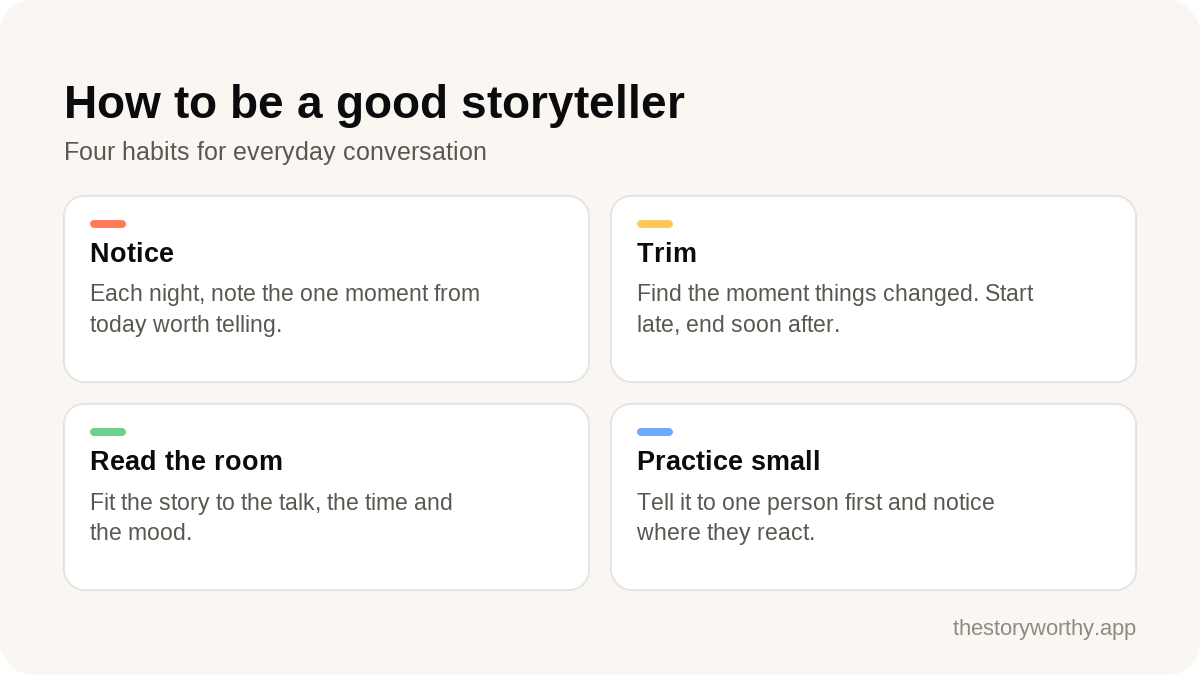
To be a good storyteller in everyday conversation, you don’t need a dramatic life or a big personality. You need four habits: notice small moments as they happen, trim each story down to the moment where something changed, read the room before and while you tell it, and practice on small audiences. Do that for a few months and stories start coming out naturally at dinners, parties and work.
What makes a good storyteller?
A good storyteller tells true, specific stories that get to the point fast and fit the people listening. They start close to the action, include one vivid detail, build to a single moment of change, and stop soon after. Above all, good storytellers have a supply of stories, because they notice and remember small moments from their own lives.
What good storytellers do differently
Watch someone who tells great stories at a dinner party and you’ll notice they aren’t doing anything mysterious.
- They have more stories ready. Not because more happens to them, but because they noticed and kept more of what happened.
- They start late. No “So, this was a few years ago, I think it was a Tuesday…” They begin in the scene.
- They know where the story is going. The middle has a direction; the end has a payoff.
- They watch their listeners. If attention drifts, they speed up or wrap up.
- They stop. They don’t explain the story after telling it.
Each of these is a habit you can learn.
Notice: collect moments daily
The biggest difference between people who tell stories and people who don’t isn’t skill. It’s supply. When a conversation opens a door (“Has anything like that ever happened to you?”), good storytellers have something to walk through it with.
The storyteller and teacher Matthew Dicks describes a daily practice he calls “Homework for Life” in his book Storyworthy: at the end of each day, write down the most story-worthy moment from it, even if it seems small. Over time you notice far more, because your brain starts looking for moments as they happen. We’ve written a full explainer of Homework for Life if you want to try it. (The Storyworthy app shares the name but isn’t connected to the book or its author.)
Try it tonight:
- Ask: if I had to tell one story from today, what would it be?
- Write one or two lines. “Neighbor’s kid tried to sell me my own newspaper.”
- That’s it. Don’t write the whole story.
After a few weeks, you’ll catch moments in real time and think, “That’s going in tonight’s list.”
Trim: find the five-second moment
Most stories people tell in conversation are too long. The fix is to find the center of the story, the point where something changed, and cut toward it.
Dicks calls this the “five-second moment”: the brief instant of change or realization a story is really about. Everything else is setup. Once you know your five-second moment, you know what to keep and what to drop.
How to trim a story for conversation in 6 steps
- Name the moment. “The second I realized my dad had been letting me win at chess for years.”
- Start as late as you can. Begin at the scene closest to that moment that still makes sense.
- Keep one detail. The smell, the object, the exact words said. One is enough.
- Cut side characters. If they don’t affect the moment, drop them.
- Cut the backstory. Say it in a phrase (“we’d just moved”) or not at all.
- End right after the moment. One line of what it meant, or nothing.
For the full structure, see how to tell a story.
Read the room
The same story can land or flop depending on who’s listening and when. Before you tell it, ask:
- Does it connect to what we’re talking about? Stories that answer the conversation feel natural. Stories that hijack it feel like a performance.
- Is it the right length for this moment? A story that works over dinner might be too long in a hallway.
- Will everyone get it? Inside jokes and work stories can leave people out.
- Is the mood right? A heavy story after a light one needs a bridge.
| Setting | Good length | Best kind of story | Watch out for |
|---|---|---|---|
| Hallway or coffee line | 15–30 seconds | A funny thing from today | Taking too long |
| Dinner party | 1–2 minutes | Travel, family, mishaps | Hogging the floor |
| First date | Under a minute | Something that shows who you are | Heavy topics |
| Work meeting | 30 seconds | A customer or team moment | Making it about you |
| With kids | 1–3 minutes | When you were their age | Too many lessons |
While you tell it, keep watching. If eyes drift, skip to the moment. If someone leans in, you can slow down and enjoy it.
Practice on small audiences
Comedians test jokes in small clubs before big shows. You can do the same with stories.
- Tell a new story to one person first. A partner, a friend, a coworker you trust.
- Notice where they react. That’s where your story really is.
- Tell it again a week later. You’ll tighten it without trying.
- Record it once. Hearing yourself shows filler you never noticed.
Most good conversational stories have been told several times. The teller has learned where the laugh comes and how long to pause. That’s practice, not talent.
Keep a story bank
A story bank is a place where all your stories live: the daily moments you noticed, the ones you’ve trimmed, and notes on where each works. When you’re heading to a wedding, an interview or a dinner with new people, you look through it and pick two or three.
What to keep for each story:
- A short title (“Dad and the chess games”)
- The five-second moment, in one line
- Who’s in it
- Where it works (dinner, a toast, an interview, with kids)
For ideas of what kinds of stories to collect, browse storytelling examples.
How to be a good storyteller: FAQ
How can I become a better storyteller?
Collect moments every day, so you always have material. Find the moment of change in each story and cut everything that doesn’t lead to it. Tell stories to one or two people first and notice where they react. Recording yourself once helps you hear filler and pacing. Improvement comes mostly from repetition, not talent.
How do you tell a good story in conversation?
Connect it to what’s being discussed, start in the scene rather than with background, include one vivid detail, build to the moment where something changed and stop soon after. Keep most conversational stories under two minutes, and hand the conversation back when you’re done.
Are good storytellers born or made?
Mostly made. Some people are naturally comfortable in front of others, but the core skills (noticing moments, trimming stories and reading listeners) are habits anyone can build with practice. Many confident storytellers were once people who didn’t think they had any stories worth telling.
What is the five-second moment?
It’s an idea from Matthew Dicks’ book Storyworthy: the brief instant of change or realization at the heart of a story. Identifying it tells you where the story starts, what to cut and where it ends.
A story bank in your pocket
Storyworthy is a voice journal built around these habits. Talk for about 30 seconds a day and it writes the moment down, titles it and tags it by emotion, people and where it can be told. When you need a story, ask a question, like “something funny for a dinner with new people,” and open a telling guide with the hook, the beats and a short version to practice.
It isn’t in the app stores yet. Join the waiting list.