Storytelling Examples: 10 Short Stories and Why They Work
Ten short, original storytelling examples from everyday life, broken down beat by beat, so you can see what makes a good story and copy the moves.
The best way to learn storytelling is to see it done. Below are ten short storytelling examples from everyday life (an embarrassing moment, a turning point at work, a family story, a travel mishap and more), each followed by a quick breakdown of why it works. They’re original, about 30 to 60 seconds when told out loud, and built from moves you can borrow for your own stories.
What makes a good story?
A good story puts the listener inside one specific moment and shows something changing. It has a clear hook, a scene you can picture, something at stake, a turn where things shift, and an ending that shows what was different afterward. Good personal stories are usually short, concrete and honest, and they end on a change in the teller.
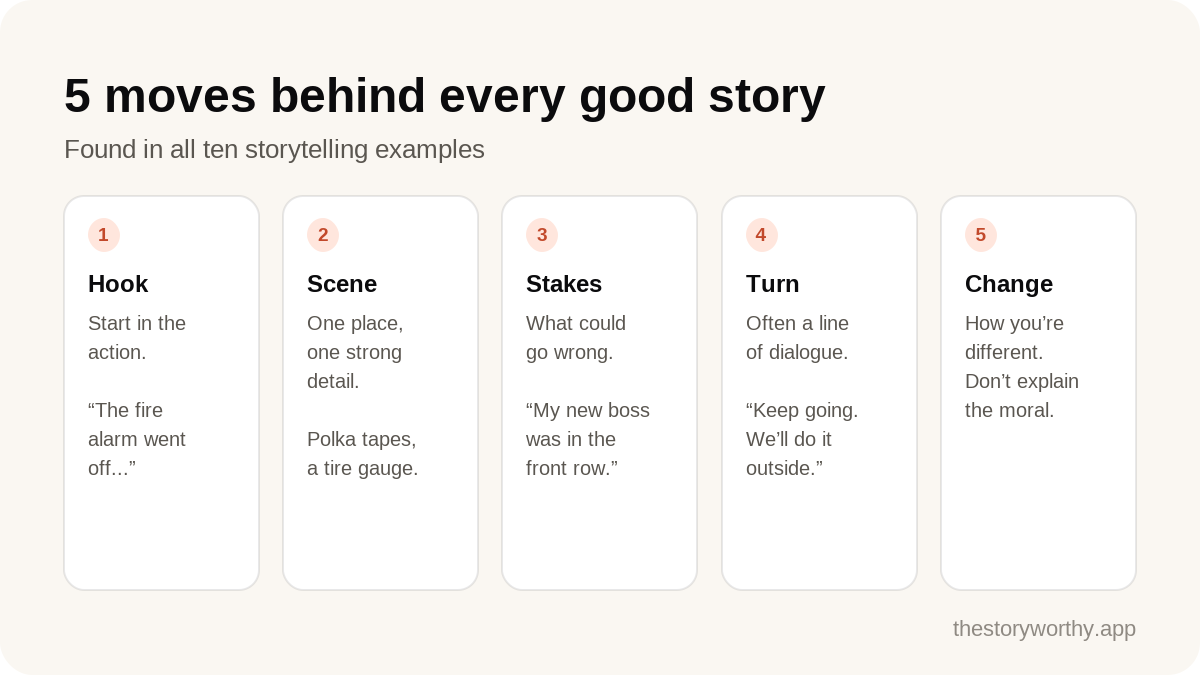
These are the moves you’ll see in every example below:
| Move | What it does | Example line |
|---|---|---|
| Hook | Opens in the middle of action | “The fire alarm went off during my first presentation.” |
| Scene | Puts the listener somewhere real | “A conference room that smelled like burnt popcorn.” |
| Stakes | Shows what could go wrong | “My new boss was in the front row.” |
| Turn | The moment things change | “She stood up and said, ‘Keep going. We’ll do it outside.’” |
| Change | How the teller is different | “I’ve never been scared of a presentation since.” |
Example 1: The small embarrassing moment
“I waved back at a woman across the street who was very clearly waving at someone behind me. I didn’t just wave; I did the big, both-arms wave. She looked confused. The man behind me looked confused. And instead of putting my arms down like a normal person, I panicked and kept going, turning it into a stretch. A full stretch, on a sidewalk, in jeans. Now whenever I feel awkward at a party, I think, ‘At least I’m not stretching on Main Street.’”
Why it works: It starts with the mistake, no setup. The escalation (wave, then stretch) builds the laugh. The ending turns a silly moment into something useful.
Example 2: The turning point at work
“Six months into my first sales job, I’d closed exactly zero deals. My manager called me into her office, and I was sure I was being fired. She shut the door, sat down, and said, ‘Read me your pitch.’ I read it. She said, ‘Now tell me why you’d buy this.’ I talked for two minutes without looking at the paper. She said, ‘Do that.’ I closed my first deal that Thursday.”
Why it works: Clear stakes (getting fired), a turn built on dialogue, and a short, concrete result. Notice how little backstory there is.
Example 3: The family story
“My grandfather never said ‘I love you.’ Not once, that I heard. But every time I left his house, he’d walk me to my car, check the tire pressure with a gauge he kept in his shirt pocket, and say, ‘Drive like you’ve got somewhere to be tomorrow.’ He died when I was 26. I keep a tire gauge in my glovebox. I’ve never used it. I just like that it’s there.”
Why it works: A specific, repeated ritual stands in for a big emotion the teller never names. The ending is an object, not an explanation, which lets the listener feel it.
Example 4: The funny travel mishap
“On my first trip to Mexico City, I practiced one phrase all week: ‘Where is the bathroom?’ At the museum, I finally used it. The guard smiled and answered in a long, fast sentence. I nodded, said ‘Gracias,’ and walked confidently in the direction of his hand. It was the exit. I was outside. My ticket didn’t let me back in. I spent the next hour at a café across the street, where, to be fair, there was a bathroom.”
Why it works: Setup and payoff: the one phrase you learned is the one that fails. The final line is a twist that turns frustration into a joke.
Example 5: The moment of courage
“In eighth grade, a kid named Devin got his backpack dumped in the cafeteria every day. Everybody laughed, including me. One Tuesday, I didn’t. I don’t know why. I just picked up his math book and handed it to him. Nobody said anything. The next day, two other kids helped pick up his stuff. A week later, it stopped. I’ve thought about how little it took.”
Why it works: The teller admits their own part (“including me”), which makes it honest. The action is tiny, and the ending reflects on exactly that.
Example 6: The first date story
“Our first date was supposed to be a picnic. It rained so hard we ended up eating sandwiches in her car with the windows fogged up, listening to her grandmother’s polka tapes because the radio was broken. Around the third song, she said, ‘If you can survive this, you can survive anything.’ We’ve been married eleven years. The tapes are still in the car.”
Why it works: A plan goes wrong and turns out better. One odd detail (polka tapes) makes it memorable, and the callback in the last line ties it up.
Example 7: The lesson from a stranger
“My flight was canceled, and I was yelling at the gate agent. Not proud of it. An older man behind me waited until I was done, then said quietly, ‘She didn’t cancel your flight.’ I turned around ready to argue, and he just smiled. I apologized to the agent. She rebooked me on a better flight. I think about that guy every time I’m about to lose it at someone who’s just doing their job.”
Why it works: The teller isn’t the hero, and admitting that makes it relatable. The stranger’s single line is the turn.
Example 8: The parenting moment
“My son, who was five, asked why the moon follows our car. I started explaining distance and perspective. He listened politely and then said, ‘I think it just likes us.’ I stopped explaining. Now, on night drives, he checks if it’s still following, and I say, ‘It still likes us.’”
Why it works: Short, sweet and built on a child’s line. The teller changes by choosing wonder over facts, and the ending shows that change as a new ritual.
Example 9: The career-change story
“I was an accountant for nine years. One Saturday I volunteered to cook for a church fundraiser because nobody else would. I made 200 servings of my mom’s chili. Watching people come back for seconds, I felt something I’d never felt closing a quarter. Monday morning, I signed up for an evening culinary course. I opened my food truck four years later.”
Why it works: A clear before and after, with one small moment as the hinge. It’s specific (200 servings, nine years) without being long.
Example 10: The quiet loss
“After my mom died, I couldn’t make myself delete her number. About a year later, I called it, just to hear her voicemail. A stranger answered. The number had been reassigned. I hung up, then called back and told him why I’d called. He was quiet, then said, ‘Do you want to tell me about her?’ I talked for twenty minutes. I never got his name.”
Why it works: The twist (a stranger answering) is unexpected but believable. The ending is understated, and the unanswered question stays with you.
The patterns behind all of them
Look across the ten examples, and the same moves keep appearing:
- They start late. No “So, a few years ago, I was living in…” The first sentence is already the story.
- They live in one scene. A sidewalk, an office, a car, a museum. One place, one time.
- They use one strong detail. Polka tapes, a tire gauge, 200 servings of chili.
- The turn is often a line of dialogue. “Do that.” “She didn’t cancel your flight.” “It just likes us.”
- The teller changes. Not necessarily a big change, but something is different at the end.
- They don’t explain the moral. The ending implies it.
- They’re short. Every example here is under a minute out loud.
To learn the method behind these moves step by step, see how to tell a story. For even shorter forms, these anecdote examples show stories you can tell in 20 seconds.
Find your own versions
Every story above is the kind of thing that happens to most people. You’ve had an embarrassing moment, a lesson from a stranger, a plan that went wrong in a good way. The difference is that someone noticed it and shaped it.
To find yours, go through the ten categories and ask, “When did something like this happen to me?”
- My most embarrassing public moment.
- A turning point at work or school.
- A ritual someone in my family had.
- A trip that went wrong.
- A small act of courage.
- A first date or early relationship moment.
- A line from a stranger I still remember.
- Something a child said.
- A moment that changed my direction.
- A loss and one small detail from it.
Write a few words for each. Then pick one and tell it to someone this week. If you want to get better at the telling itself, how to be a good storyteller covers the habits that help.
Storytelling examples FAQ
What is an example of a personal story?
A personal story is a true moment from your own life, told with a beginning, a turn and an ending. For example: getting lost on your first trip abroad and finding your favorite café because of it. It doesn’t need to be dramatic; it needs a clear moment where something changed.
How long should a personal story be?
Most everyday personal stories work best at 30 seconds to two minutes. Shorter stories fit conversations, dates and meetings; longer ones, up to about three minutes, can work in speeches. Every example in this article is under a minute when told out loud.
What are the elements of good storytelling?
A hook that starts in the action, one clear scene, stakes the listener understands, a turn where things change, and an ending that shows the change. Specific details and a line of dialogue help most stories. Leaving out unnecessary backstory helps almost all of them.
How do I find stories from my own life?
Look for moments with a small change in them: something that surprised you, embarrassed you, or taught you something. Keep a short daily note of one such moment. Over weeks you’ll have a long list to pick from when you need a story.
Keep your stories with Storyworthy
Storyworthy is a voice journal for exactly these kinds of moments. You record a story in about 30 seconds (or type it), and AI gives it a title and tags it by emotion, people and where it could be told. For any story, it writes a telling guide with the hook, the scene, the beats, the twist and a version for each telling style, short, funny or heartfelt.
It’s not in the app stores yet. Join the waiting list.