Public Speaking Tips: Lead With a Story
Public speaking tips that actually work: open with a short personal story, calm your nerves, pace yourself and practice out loud so people remember your talk.
The most useful public speaking tip is to open with a short, true story instead of a thank-you or an agenda. A story gets the room’s attention in the first ten seconds, gives you something easy to say while your nerves settle, and makes your point stick after the slides are forgotten. Below: how to pick that story, handle nerves, pace yourself and practice so the talk sounds like you on a good day.
What are the best public speaking tips?
The best public speaking tips are simple: open with a short personal story, make one clear point, slow down and pause on purpose, look at one person per thought, and practice out loud while recording yourself. Memorize your opening and closing, not every word, and keep a bank of real stories so you never start from a blank page.
Open with a story, not a thank-you
Most talks start the same way: “Thank you so much for having me. Today I’m going to talk about three things…” The audience hears that and reaches for their phones. Nothing has happened yet.
Compare it with this:
“Last March I stood in a parking lot at 6 a.m., holding a box of 200 name badges that all said the wrong date.”
Now people want to know what happened. You have their attention before you’ve said what the talk is about.
A good opening story has four things:
- A time and a place. “Last March, in a parking lot” puts the audience somewhere.
- You in it. Your own stories are easier to tell and more believable than “a friend of a friend.”
- Something at stake. A problem, a choice, a moment of doubt.
- A link to your point. The badges story can open a talk about checking assumptions, planning events or asking for help.
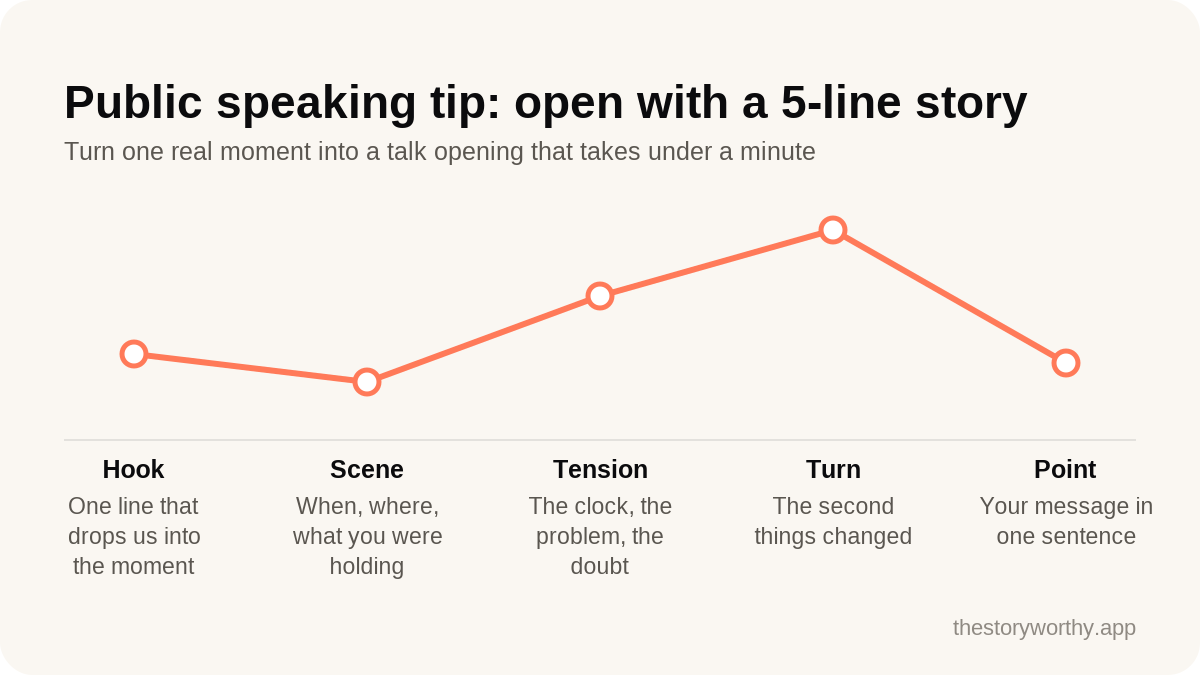
Keep it under a minute. Tell the story, land the moment, then say the point in one sentence: “That morning taught me to check the one thing everyone assumes is fine.” Thank the organizers after that if you like. It lands better once people are listening.
Pick stories that fit the point
A funny story that has nothing to do with your message gets a laugh and then leaves people confused. Work backwards from what you want them to remember.
How to tell a story in a speech in 6 steps
- Write the point. Put your main message in one sentence, such as “Small teams move faster when they share bad news early.”
- Search your memory. Ask when you saw this happen or learned it the hard way.
- List three moments. Small ones count: a meeting where someone admitted a mistake, a kid’s soccer team that improved once the coach let them call out problems.
- Find the turn. Pick the moment with the clearest second where things changed.
- Cut the setup. Start as close to that second as you can; most first drafts have 20 seconds of throat-clearing.
- Say the point out loud. End the story with one plain sentence that connects it to your message.
For more on structure, see how to tell a story, and for openings in different settings, storytelling examples.
Which story fits which talk
| Kind of talk | Story to look for | Length |
|---|---|---|
| Work presentation | A customer moment or a mistake you caught late | 30–60 seconds |
| Wedding toast | One specific memory with the couple | 45–90 seconds |
| Conference talk | When you realized the problem was real | 60–90 seconds |
| Team meeting | Something that happened this week | 20–30 seconds |
| Class or club talk | The first time you tried it and got it wrong | 30–60 seconds |
For toasts specifically, the wedding toast guide goes deeper.
Nerves: what actually helps
Almost everyone gets nervous before speaking. The goal isn’t to stop feeling it; it’s to keep it from running the talk.
- Know your first 30 seconds cold. Nerves peak at the start. If the opening story is rehearsed, your mouth knows what to do while your heart rate settles.
- Breathe out longer than you breathe in. In for four counts, out for six or eight, a few times before you walk up.
- Arrive early and stand where you’ll speak. Check the clicker, the mic, the water. Fewer surprises, fewer worries.
- Talk to one friendly face. Find someone nodding and speak to them for a sentence, then move on.
- Call it excitement. A racing heart before a talk feels a lot like being ready. “I’m ready to go” often works better than “calm down.”
What usually doesn’t help: memorizing every word. Lose one sentence and the whole script collapses. Memorize the opening, the closing and the order of your points, and speak the rest.
Pace, pauses and eye contact
Slow down more than feels right. Nervous speakers rush. What feels slow to you sounds normal from the seats. If you can’t hear a breath between sentences on a recording, you’re too fast.
Pause on purpose. Put pauses right before the turn of a story (“And then she opened the box.” Pause.), after a line you want remembered, and between sections. Two seconds of silence feels long on stage and natural in the audience.
Make eye contact in chunks. Hold one person’s gaze for a full thought, then move to someone in another part of the room. Scanning fast looks nervous; staring at the back wall looks distant.
Trade filler for silence. “Um” isn’t a disaster. Replacing it with the pause you were filling makes you sound more confident straight away.
Practice out loud and record yourself
Reading your notes silently isn’t practice. You need to hear the words, because spoken sentences are shorter and plainer than written ones. Recording yourself is uncomfortable at first, and it’s also the fastest way to hear the gap between what you meant and what you said.
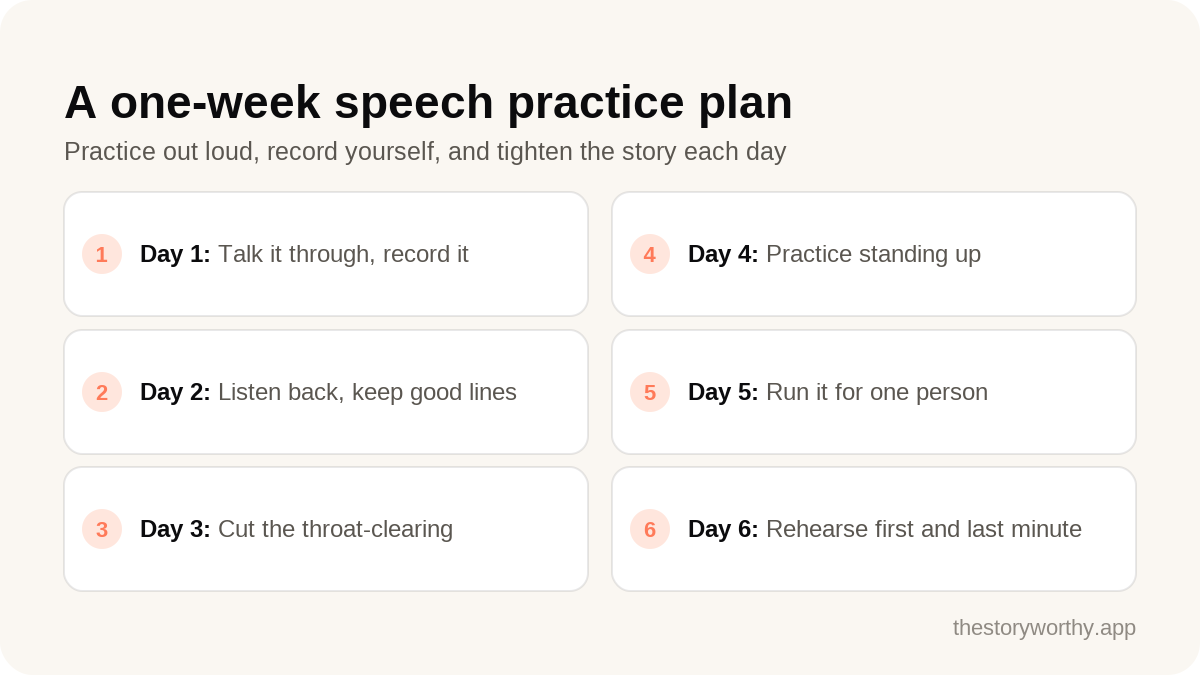
On day 5, ask your one listener a single question: “What do you remember?” If they don’t mention your point, the story isn’t connected to it clearly enough.
Sample lines for common moments
- Opening a work talk: “Two years ago I made a decision that cost us a client. Here’s what happened.”
- Moving to your point: “I’ve thought about that morning a lot, and here’s what I took from it.”
- When you lose your place: “Let me come back to where I was,” then look at your notes. Nobody minds.
- Closing: Return to the opening. “I still have one of those badges with the wrong date. It’s on my desk, and it reminds me to check.”
Ending where you started gives the talk a shape people feel even if they can’t name it.
Keep a bank of stories for any talk
The hardest part of storytelling in public speaking isn’t telling the story. It’s remembering you have one when you sit down to write. Under pressure your mind goes blank, and you fall back on quotes you found online.
Good speakers solve this ahead of time. They keep a running list of moments from their own lives: the awkward first day at a job, the stranger who helped, the trip that went wrong in a useful way. You can start tonight:
- Note one moment that stood out today. Just one. “The bus driver waited for the woman running with groceries.”
- Add one line about why it mattered. “Small kindness, nobody asked him to.”
- Tag where you might use it. Work, a toast, a talk about community, a story for your kids.
After a few months you’ll have dozens, and you’ll start noticing more as they happen. A note like “locked out of the office the morning of the board meeting” becomes an opening in five lines: the hook (“I gave my first board presentation through a window”), the scene, the tension, the turn, and the point.
Public speaking tips: FAQ
How can I be a better speaker quickly?
Pick one real story that supports your point and rehearse it out loud until you can tell it without notes. Then slow down, pause before key lines and record one full run-through. Listening back once shows you more than reading a dozen tips. Most people improve fastest by fixing pace and openings, not vocabulary.
How long should a story in a speech be?
For most talks, 30 to 90 seconds. Long enough to set a scene and reach a turning point, short enough that the audience stays with you. In a five-minute talk, one story is plenty. In a 30-minute talk you can use two or three, each tied to a different point.
How do I stop shaking when I speak in public?
You probably won’t stop it completely, and the audience notices far less than you think. Hold something steady, like notes on card or the edge of a lectern, plant your feet, and use long exhales before you start. Knowing your opening by heart helps most, because nerves fade once you’re a minute in.
Should I memorize my speech?
Memorize the first and last lines and the order of your points. Speak the rest from understanding, with short notes if you need them. Word-for-word memorizing sounds stiff and breaks down if you lose one line, while a story you know well comes out naturally every time.
Build your story bank with Storyworthy
Storyworthy is a voice journal for exactly this. You talk for about 30 seconds a day, or type if you’d rather, and the app writes it down, gives the story a title and tags it by emotion, the people in it and where it could be told, like a toast or at work. Before your next talk, ask it for “a story about a mistake that taught me something” and get your own stories back, then open a telling guide with the hook, the scene, the beats and a few versions to try out loud.
Storyworthy isn’t in the app stores yet. Join the waiting list to hear when it opens.