How to Write a Eulogy: Stories That Honor a Life
How to write a eulogy built on a few true stories: gather memories, choose three, follow a simple structure, and use sample openings and closings.
If you’ve been asked to write a eulogy, you’re probably doing it while grieving and short on time. The simplest way through is this: gather a handful of memories from people who knew them, choose three true stories that show who they were, and set those stories inside a short structure. You don’t need to sum up a whole life. You need to help the room see the person one more time.
What is a eulogy?
A eulogy is a short speech given at a funeral or memorial that honors the person who died. It usually runs three to seven minutes and shares who they were through a few personal stories, what they cared about and what they meant to the people in the room, rather than a full list of life events.
Gather memories from family and friends
You don’t have to write it alone, and you shouldn’t try to rely only on your own memory in the middle of grief. Other people hold pieces you don’t.
Reach out to a few people: a sibling, an old friend, a coworker, a neighbor. Keep the ask small:
- “I’m writing the eulogy for Dad. Is there one moment with him you think of first?”
- “What’s something Ruth always said?”
- “What would people who only knew her at work not know about her?”
Collect everything in one place, even fragments: “always hummed while driving,” “kept butterscotch in every coat pocket,” “called everyone ‘chief.’” Small details like these are often what people remember most from a eulogy.
If you can, ask by voice. Many people find it easier to talk about someone than to write about them, and recorded memories keep the way they were told. The questions to ask grandparents guide has gentle questions that work for this too.
Choose three stories
Three is enough. One story can feel thin; six turns into a list. Three gives the room a shape: something to remember, something to laugh at, something to hold onto.
Look for stories that show different sides of the person:
- Who they were at home. The Saturday pancakes, the way they answered the phone.
- Who they were in the world. Their work, their community, the friend they were to others.
- What they taught or gave. A moment where their values showed without anyone naming them.
A good eulogy story is specific. “She was generous” is a statement. “She paid for the stranger’s groceries behind her, then insisted it was because she had too many coupons” is a story. Let the story carry the quality; you don’t have to name it.
For each story, find the moment at its center: the one line, the gesture, the thing they said. Build toward that, then stop. The how to tell a story guide explains how to find that moment.
A simple eulogy structure
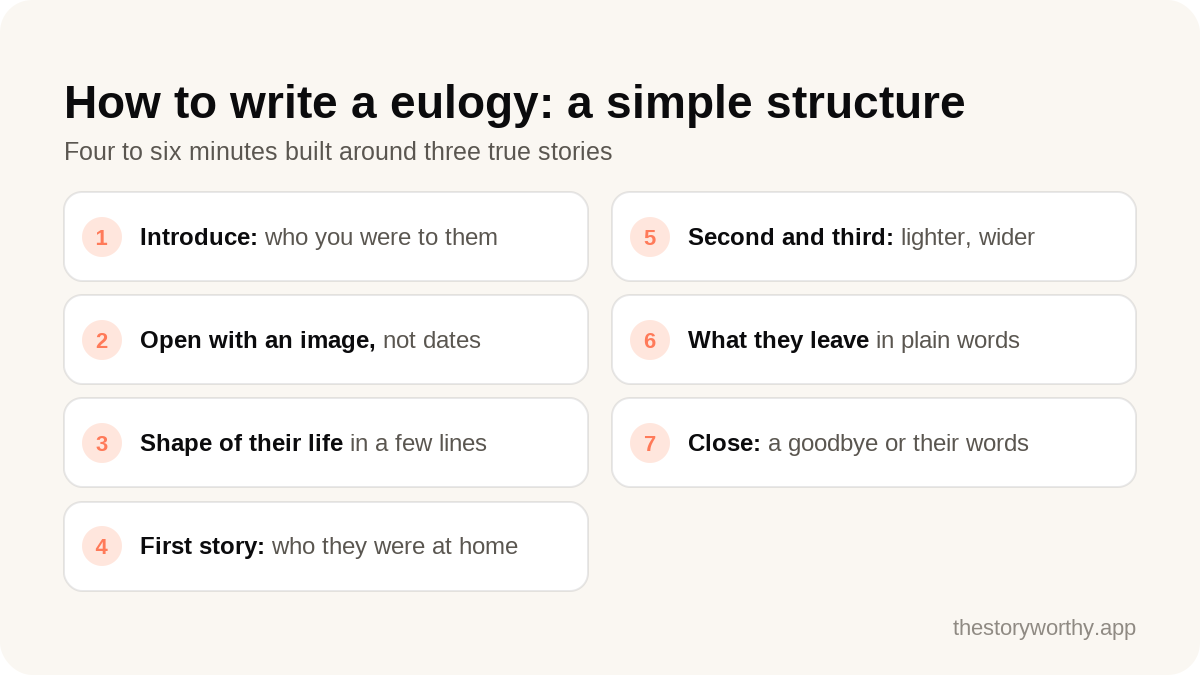
How to write a eulogy in 7 steps
- Introduce yourself. Say who you are and how you knew them, in one or two sentences.
- Open with an image. Start with one picture of them, not their dates of birth and death.
- Give a little shape to their life. A few lines on where they came from and what filled their years.
- Tell your first story. Usually the warmest or the one that shows who they were at home.
- Tell the second and third. Include a lighter one if it fits the person.
- Say what they leave behind. What they gave you and others, in plain words.
- Close by speaking to them or about them. A last image, a goodbye or something they always said.
| Part | What to say | Rough time |
|---|---|---|
| Introduction | Who you are and how you knew them | 15 seconds |
| Opening image | One picture of them | 30 seconds |
| Their life, briefly | Where they came from, what they loved | 45 seconds |
| Three stories | Specific moments that show who they were | 2–4 minutes |
| What they leave | What they gave the people here | 30 seconds |
| Closing | A goodbye or their own words | 15–30 seconds |
That adds up to about four to six minutes, which suits most services. If several people are speaking, ask the family or officiant how long you have and trim stories rather than speeding up.
Sample openings and closings
These are starting points. Change the details until they sound like you and like them.
Openings
- “My name is Daniel, and I was lucky enough to be Frank’s son-in-law for 22 years. The first thing he ever said to me was, ‘Can you fix a gutter?’ I couldn’t. He taught me.”
- “If you knew Grandma Lou, you know she never let anyone leave her house without food. I’m fairly sure some of you still have her Tupperware.”
- “Most of you knew Maya as a nurse. I knew her as the person who called me every Sunday at 7 p.m., without fail, for 30 years.”
- “I’ve been trying all week to find a way to describe my brother, and I keep coming back to his laugh.”
Closings
- “Dad, thank you for the gutters, and for everything else. We’ve got it from here.”
- “So the next time someone hands you a container of leftovers you didn’t ask for, think of Lou. And maybe bring the Tupperware back.”
- “It’s Sunday, Maya. I’ll keep my phone on.”
- “He always ended phone calls with ‘Go do something good.’ So that’s what I’ll ask of all of you.”
Humor in a eulogy
Humor is welcome in many eulogies, and often a relief. Laughing together at a funeral is a way of saying “yes, that was them.”
A few guidelines:
- The humor should come from who they were. Their habits, their sayings, their stubbornness. Not jokes you found elsewhere.
- It should be affectionate. Would they have laughed? Would their family? If you’re unsure, leave it out.
- Follow it with warmth. A funny story can lead straight into what it showed: “That was Grandpa. He’d argue with the GPS for an hour, and he’d drive anyone anywhere.”
- Read the room and the culture. Some families and traditions expect a solemn tone. Ask if you’re not sure.
Delivering it
This is the part people fear most. A few things make it easier.
- Print it in large type. 16 or 18 point, double spaced. Grief and nerves make small text hard to read.
- Mark where to breathe. A slash or a line break before the hard parts.
- Read it out loud several times beforehand. The words lose some of their sting each time, which helps you get through them on the day.
- It’s all right to stop. If your voice breaks, pause, take a breath, sip water. Nobody in the room will mind. They’re with you.
- Have a backup. Give a copy to someone who can read it for you if you can’t continue.
- Look up during the stories. You don’t need to hold eye contact. Glancing up at familiar faces helps.
How to write a eulogy: FAQ
How long should a eulogy be?
Most eulogies run three to seven minutes, roughly 500 to 900 words when spoken at a calm pace. If several people are speaking, aim for the shorter end and ask the family or officiant for a time limit. A short eulogy built on one or two strong stories is better than a long one that loses the room.
What should you not say in a eulogy?
Avoid family conflicts, private matters the person wouldn’t want shared, inside jokes most people won’t understand, and long lists of achievements. Don’t make it about yourself beyond a brief introduction. If a story might embarrass the family or hurt someone present, leave it out, however funny it is.
How do you start a eulogy?
Introduce yourself briefly and how you knew the person, then open with one image or moment that captures them: a habit, a phrase they said, a scene from a normal day. Starting with something specific draws the room in more gently than starting with dates and biography.
Can I read a eulogy from paper?
Yes, and most people do. Print it in large type, mark your pauses and glance up during the stories. No one expects a eulogy to be memorized, and having the text in front of you lets you get through it even if emotion makes you lose your place.
Keeping their stories
Writing a eulogy often makes people realize how many stories they almost lost. Many families start collecting them afterwards: what an aunt remembers, what a friend said at the service. The family stories guide covers how to keep them.
Storyworthy is a voice journal where you can talk through a memory in about 30 seconds and have it written down and tagged with the people in it, so those memories are there when you need them. It’s private: stories stay in your account. It isn’t in the app stores yet; join the waiting list if you’d like to hear when it opens.