Family Stories: How to Collect and Keep Them
How to preserve family stories: where to start, how to record relatives over the holidays, writing down your own, and organizing them by person and theme.
Family stories disappear quietly. Nobody decides to forget how Grandpa crossed the border or why Aunt June never eats peaches; the people who knew just stop being asked. To keep them, you need three things: ask the right people the right questions, record the answers (voice is easiest), and organize them by person and theme so the next generation can actually find them. The holidays are the best time to start.
What are family stories?
Family stories are the true stories a family tells about itself: how grandparents met, where the family came from, funny disasters, hard times survived and traditions and how they started. They carry family history and values between generations, and they’re usually passed on by talking, which is why they’re easy to lose.
Why family stories get lost
- They live in one person’s head. Often the oldest relative, and often nobody has asked.
- They’re told, not written. A story told at every Thanksgiving still vanishes when the teller does.
- Nobody feels like the “family historian.” Everyone assumes someone else is keeping track.
- They seem too ordinary. “Oh, that’s just Mom’s story about the bakery.” Until nobody remembers it.
- Recordings pile up unlabeled. Even families who record end up with files called “Voice Memo 47.”
The good news: every one of these is fixable with small habits.
Where to start
Don’t start with a big project. Start with one person and one story.
- Pick the person whose stories you’d miss most. Usually a grandparent, parent or older aunt or uncle.
- Pick one story you half-know. “You always mention the summer on the farm. What happened?” A story you’ve heard pieces of is the easiest door.
- Bring something. A photo, a recipe card, an old letter. Objects unlock memories.
- Ask for moments, not summaries. “What do you remember about the day you arrived?” works better than “Tell me about your life.”
For a full list of questions by theme (childhood, love, work, hard times), see questions to ask grandparents.
Recording conversations
Recording is the single most valuable thing you can do. It keeps the exact words, the voice, the laugh, the way a story is told, and that’s often what you’ll treasure most.
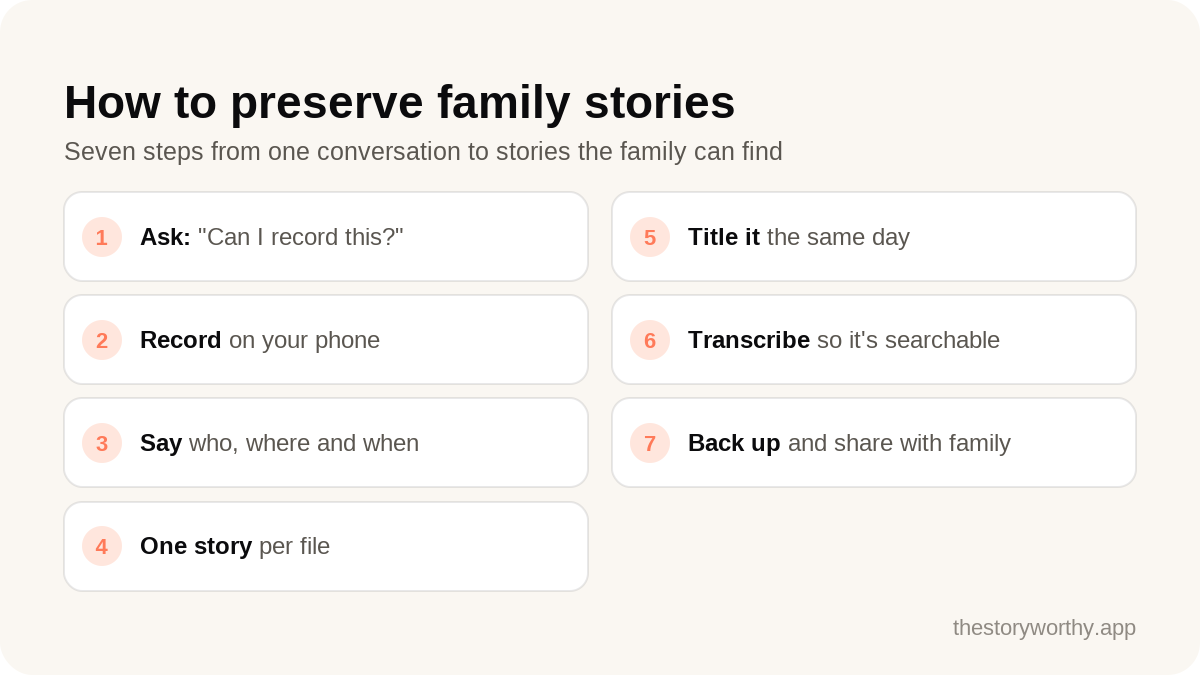
How to preserve family stories in 7 steps
- Ask permission. “Can I record this? I don’t want to forget anything.”
- Use your phone. Set it on the table, not in their face. Test ten seconds first.
- Say who, where and when. “Thanksgiving 2026, Grandma Rose’s kitchen.”
- Keep each recording short. One story per file is much easier to find later.
- Title it the same day. “Grandma Rose on the bakery fire.” Unlabeled recordings get lost.
- Get it written down. A transcript makes stories searchable and quotable.
- Back it up and share it. Keep copies in more than one place and send them to relatives.
Holiday gatherings are ideal because several generations are in one place, and one story often sparks another: “No, that’s not how it happened, it was raining!” Those disagreements are part of the story. Record them too.
Writing down your own family stories
You’re part of the family history. Your memories of your grandparents, your own childhood, your kids’ early years: these are family stories too, and you’re the only one who has them.
Ways to start:
- Write one memory a week. “The smell of Grandpa’s workshop.” “The night the power went out and Mom told ghost stories.”
- Tell stories about your kids to your kids. The day they were born, their first word, the time they hid in the laundry basket. Kids love hearing stories about themselves, and it keeps those memories alive.
- Keep a story about every relative. Even one per person is a start.
- Speak it if writing feels slow. A 30-second voice note captures a memory faster than a page.
If you want to take this further, how to write a memoir shows how these short pieces can grow into something longer.
Organizing by person and theme
A collection of stories is only useful if people can find them. Organize two ways at once:
| By person | By theme | Example story |
|---|---|---|
| Grandma Rose | Immigration | Arriving in New York with one suitcase |
| Grandpa Joe | Work | The bakery fire of 1971 |
| Mom | Childhood | Summers at the lake cabin |
| Uncle Ray | Funny mishaps | The wedding cake that fell over |
| You | Parenting | The first night home with the baby |
Some themes that work for most families:
- Where we came from
- How couples met
- Work and money
- Holidays and traditions
- Hard times
- Funny disasters
- Food and recipes
Tags let one story live in several places. “The bakery fire” belongs to Grandpa Joe, to Work and to Hard times. When someone needs a story about Grandpa Joe for a birthday toast, or for a eulogy one day, it’s there. The how to write a eulogy guide shows how much those collected stories help in that moment.
Telling them at the table
Stories that are only stored aren’t really alive. The best way to keep family stories is to tell them.
- Pick one story per holiday meal. “Grandpa, tell the kids about the bakery fire.”
- Let kids ask questions. Their questions often draw out details nobody’s heard.
- Retell stories of people who are gone. “Your great-grandmother used to…” keeps them part of the family.
- Start a tradition. Each person tells one story from the year at New Year’s dinner.
Children who hear family history stories grow up with a sense of where they come from: who was brave, who was funny, who started over. That’s the real reason to keep them.
Family stories: FAQ
How do I start collecting family stories?
Start with one relative and one story you’ve heard pieces of. Ask about a specific moment, bring an old photo to spark memories and record the conversation on your phone. Title the recording the same day. Once you’ve done one, the next is much easier, and relatives often start volunteering stories on their own.
What’s the best way to record family stories?
A phone voice recorder is enough. Keep the phone on the table, record one story per file, say who’s speaking and when, and title each recording right away. Getting a written transcript makes stories much easier to search and share. Video is lovely but can make people self-conscious.
What questions should I ask to get family stories?
Ask about specific moments: how they met their partner, their first job, the house they grew up in, a hard time and who helped, a holiday they remember. Follow up with “What happened next?” and “Who else was there?” Open questions that invite a memory work much better than yes-or-no questions.
How do you organize family stories?
Tag each story by the people in it and by theme, such as immigration, work, holidays or funny mishaps. Give each a clear title and date. That way the same story can be found under several headings, and future relatives can look up everything about one person.
Keep your family stories together
Storyworthy is a voice journal for the stories of your life, and your family’s. Talk for about 30 seconds after a visit and it writes the story down, gives it a title and tags it with the people in it and the emotion, so you can later ask, “stories about Grandpa Joe,” and find them. Stories stay private in your account.
It isn’t in the app stores yet. Join the waiting list.