How to Write a Memoir: Start With Small Stories
How to write a memoir without freezing at chapter one: collect short scenes first, use memoir writing prompts, find your thread, then shape the book.
To write a memoir, start by collecting short scenes from your life, one memory at a time, before you think about chapters or structure. Write or record a scene a few times a week. After a few months, read them together and look for the thread that connects them. That thread becomes your memoir. This guide covers the difference between memoir and autobiography, prompts to get you started, writing about real people, and a weekly routine that adds up to a book.
What is the difference between a memoir and an autobiography?
A memoir tells a focused story from your life, built around a theme, a period or a relationship, such as your years caring for a parent or growing up above a family restaurant. An autobiography covers your whole life in order, from birth to now. Most people writing “a book about my life” are better served by memoir: it’s more focused, more personal and easier to finish.
| Memoir | Autobiography | |
|---|---|---|
| Scope | One theme, period or relationship | Your whole life |
| Order | Whatever serves the story | Usually chronological |
| Focus | What it felt like and what it meant | What happened, in full |
| Who writes it | Anyone with a story | Often public figures |
| Typical start | A scene | Birth or childhood |
Collect scenes before chapters
The biggest reason memoirs never get written is that people sit down to write chapter one. They start at birth, get three pages into childhood, and stall. The blank, book-sized task is too big.
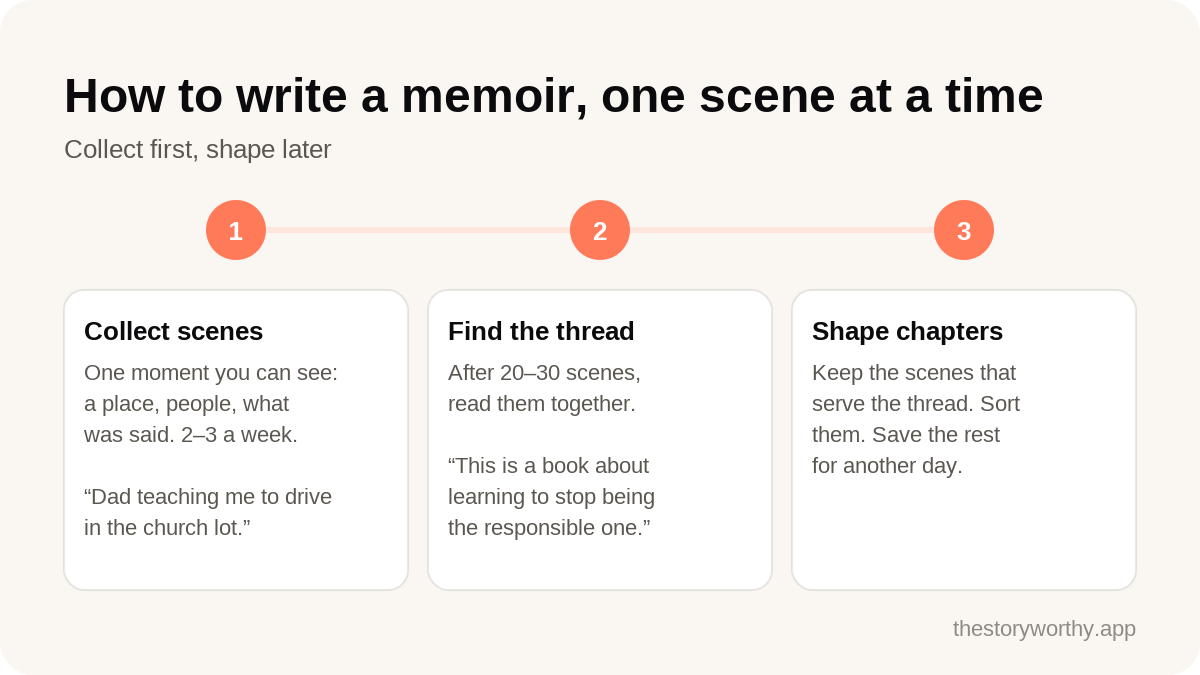
Instead, collect scenes. A scene is a single moment you can see: a place, a time, a few people, something happening. “The morning Dad taught me to drive in the church parking lot” is a scene. “My relationship with my father” is a topic.
Scenes have a few advantages:
- They’re small. You can write one in 20 minutes or record one in two.
- They’re vivid. A specific moment brings back details a summary never will: the smell, the weather, what someone said.
- They’re movable. You don’t need to know where a scene goes in the book to write it.
- They add up. Fifty scenes is the raw material for a memoir.
Write each scene as if you’re telling it to a friend. Don’t worry about prose style yet. Get the moment down.
How to start a memoir in 7 steps
- Make a list of 30 memories. Just titles, a few words each. Don’t filter.
- Pick the one you can see most clearly. That’s your first scene.
- Write or record it in one sitting. Where you were, who was there, what happened, what was said.
- Repeat two or three times a week. Different memories, no particular order.
- After 20 scenes, read them all. Look for what keeps coming back.
- Name your thread in one sentence. “This is a book about…”
- Sort scenes along that thread. Now you’re writing chapters.
Memoir writing prompts to get started
Use these to fill your first list of memories. Each one points at a specific scene.
Places
- The kitchen you grew up in. Who was usually in it, and what were they doing?
- A house or apartment you lived in only briefly.
- The place you went to be alone as a teenager.
- A car you remember better than most people.
People
- The first time you saw a parent cry or lose their temper.
- A teacher, coach or neighbor who saw something in you.
- The last conversation you had with someone who’s gone.
- A friend you lost touch with, and the last day you spent together.
Turning points
- The day you left home.
- A phone call that changed things.
- A decision you made in a few minutes that shaped years.
- The moment you realized you’d become an adult.
Small moments
- A meal you still think about.
- A smell that takes you straight back somewhere.
- A family joke and the story behind it.
- An ordinary afternoon you’d love to relive.
If you’re writing about family history, questions to ask grandparents and our guide to family stories are good companions. For daily prompts that keep memories coming, see these journal prompts.
Finding the thread that ties it together
After you’ve collected 20 or 30 scenes, read them all in one sitting. You’ll start to notice patterns: a person who’s in half of them, a feeling that keeps returning, a question you keep circling.
That pattern is your thread. A few examples of what a thread might look like:
- “This is a book about learning to stop being the responsible one.”
- “This is a book about my mother’s restaurant and what it cost her.”
- “This is a book about the year I moved to a country where I didn’t speak the language.”
Once you can finish the sentence “This is a book about…”, you know which scenes belong and which don’t. Some of your favorite scenes may not fit. Save them; they might be a different book, or a story you tell at a family dinner.
Writing true scenes about real people
Memoir means writing about real people: parents, siblings, exes, friends. That raises honest questions.
- Write from your own experience. Describe what you saw, heard and felt. You can’t know what was in someone else’s head.
- Be fair. Show people as complicated, including their good sides. Readers trust a writer who’s fair to the people in the story.
- Reconstructed dialogue is normal. Nobody remembers conversations word for word. Write what was said as closely as you remember it, true to its spirit.
- Change names if needed. Many memoirists change names or identifying details to protect privacy.
- Decide later whether to share. Write the first draft for yourself. Decisions about publishing and showing family can wait.
If you plan to publish, especially anything that could harm someone’s reputation, it’s worth getting advice from an editor or a publishing lawyer.
A weekly routine that adds up
A memoir isn’t written in a burst of inspiration. It’s written in small sessions that accumulate. Here’s a rhythm that works for many people with full lives:
| Day | What to do | Time |
|---|---|---|
| Monday | Add five memories to your list | 10 minutes |
| Wednesday | Write or record one scene | 20–30 minutes |
| Saturday | Write or record one scene | 30–45 minutes |
| Last Sunday of the month | Read all scenes back, notice patterns | 1 hour |
That’s two scenes a week, or roughly eight a month. In six months you’ll have about 50 scenes, plenty to find your thread and start shaping a draft.
Recording scenes out loud is a legitimate way to draft. Many people find they tell a memory more naturally than they write it, with better rhythm and more detail. You can transcribe and edit later.
How to write a memoir FAQ
How do I start writing a memoir with no experience?
Start with one scene, not chapter one. Pick a memory you can see clearly and write or record it as if telling a friend: where you were, who was there, what happened. Do that two or three times a week. You don’t need writing experience to capture scenes; shaping them comes later.
How long does it take to write a memoir?
It varies widely, often a year or more for a first draft. Collecting two scenes a week gives you about 50 scenes in six months, enough to find your thread and start drafting. Editing and revision usually take as long as the first draft, or longer.
Can I write a memoir if my life isn’t extraordinary?
Yes. Memoir is about how you experienced your life and what it meant, not about how dramatic it was. Many loved memoirs are about ordinary childhoods, jobs or families. What makes a memoir worth reading is specific scenes and honest reflection.
Should I write my memoir in chronological order?
Not necessarily. Collect scenes in any order, then arrange them along your thread. Some memoirs are chronological; others jump between past and present or are organized by theme. Decide the structure after you’ve gathered your scenes, not before.
Collect your scenes with Storyworthy
Storyworthy is a voice journal for the stories of your life: you record a memory in about 30 seconds (or type it), it writes your words down, and AI gives each one a title and tags it by emotion and the people in it. When you’re ready to find your thread, ask “stories about my mother” or “moments of pride” and they come back together, ready to shape into chapters.
It’s not in the app stores yet. Join the waiting list.