Questions to Ask Grandparents Before the Stories Are Lost
Questions to ask grandparents and parents about their life: childhood, love, work, hard times. Plus how to set up the talk and record the answers.
The best questions to ask grandparents aren’t about dates and facts. They ask for a moment: “What did your kitchen smell like growing up?” or “How did you know Grandpa was the one?” Below are life story questions grouped by childhood, love and family, work and moving, and hard times, plus how to set up the conversation and record the answers so they’re kept. They work just as well for your parents, at Thanksgiving or on any visit.
What are good questions to ask grandparents?
Good questions to ask grandparents are open and specific: they ask for a memory of one moment rather than a yes or no. Ask about their childhood home, how they met their partner, their first job, a hard time they got through and what they’d tell their younger self. Follow up with “What happened next?” and “What did that feel like?”
Before you start: set up the conversation
A few small choices make a big difference.
- Tell them why. “I realized I don’t know much about when you were young, and I’d love to.” Most grandparents are delighted to be asked.
- Pick a calm time. After a meal, on a walk, during a car ride. Not in the middle of a busy holiday kitchen.
- Keep it short. Twenty to forty minutes is plenty. You can come back for more.
- Bring a prompt. An old photo, a recipe card, a map. Objects unlock memories that questions alone can’t.
- Ask to record. “Would you mind if I record this so I don’t forget anything?” Most people say yes once they know it’s for family.
- Let silence work. After a question, wait. The best answers often come after a pause.
The follow-up questions matter more than the first ones. Keep a few ready:
- “What happened next?”
- “Who else was there?”
- “What did it look like?”
- “How did you feel?”
- “Do you remember what they said?”
Childhood and growing up
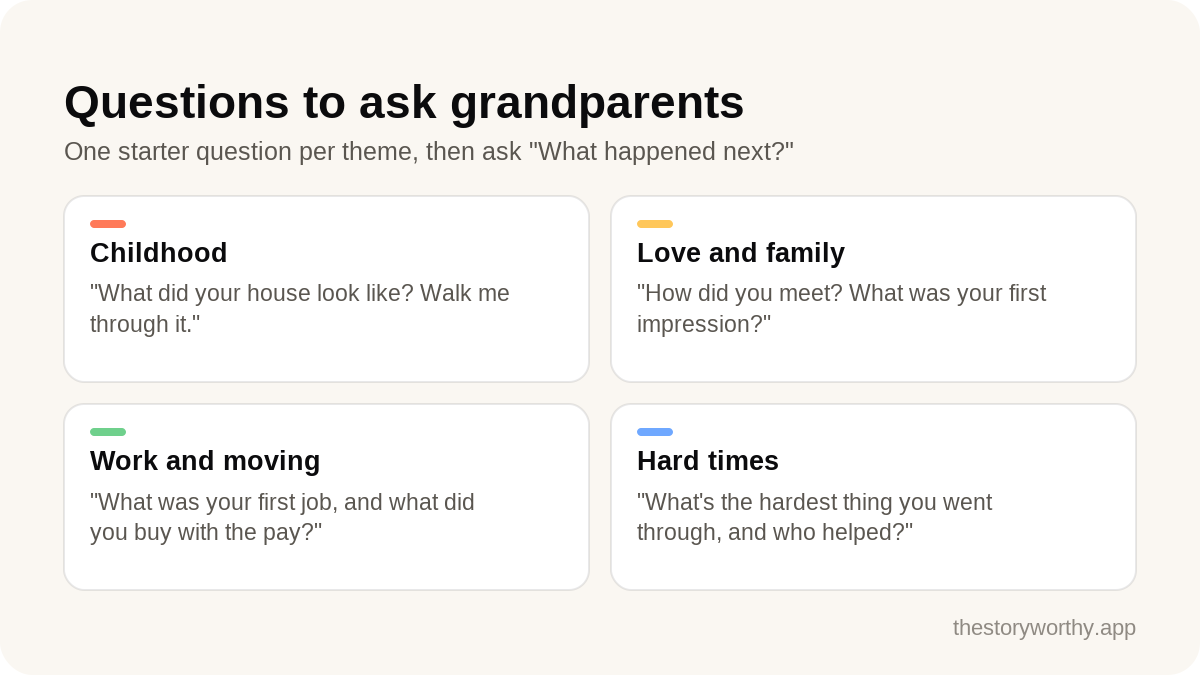
- What did your house look like when you were little? Walk me through it.
- What did your family eat on a normal weeknight? On holidays?
- What were you allowed to do that kids today aren’t, and the other way round?
- Who was your best friend, and what did you do together?
- What did you get in trouble for?
- What was your favorite thing to do on a summer day?
- What was school like? Was there a teacher you still remember?
- What did your parents do for work? What do you remember about them working?
- What’s a smell or sound that takes you right back?
- What did you want to be when you grew up?
Love, marriage and family
- How did you meet Grandma (or Grandpa)? What was your first impression?
- What was your first date like?
- When did you know this was the person?
- What was your wedding day like? What went wrong?
- What was the hardest part of the first years together?
- What was it like when your first child was born?
- What’s something about raising kids that surprised you?
- What did your family do together on weekends?
- Is there a family tradition you started? Why?
- What’s the secret to staying together, honestly?
Work, money and moving
- What was your first job? How much were you paid?
- What was the best job you ever had, and the worst?
- Was there a boss or coworker who changed things for you?
- Did you ever move far from home? What was that like?
- What did you buy with your first real paycheck?
- Were there times when money was tight? How did you manage?
- What did your town look like then, and what’s changed most?
- What are you proud of from your working life?
- What’s a skill you had that people don’t know about?
- If you could have done any other job, what would it be?
Hard times and big decisions
These need care. Ask gently, and let them decide how much to share.
- What’s the hardest thing you’ve ever been through?
- Who helped you get through it?
- What’s a big decision you made that changed your life?
- Is there something you’d do differently?
- What world events do you remember living through? Where were you?
- Who do you miss most? What do you want people to remember about them?
- What are you most grateful for?
- What would you tell your 20-year-old self?
- What do you want your grandchildren to know about you?
- What’s a story you’ve never told us?
| Theme | Starter question | Good follow-up | Object to bring |
|---|---|---|---|
| Childhood | “Walk me through your house.” | “Which room did you spend most time in?” | An old photo of the house |
| Love | “How did you meet?” | “What were you wearing?” | Their wedding photo |
| Work | “What was your first job?” | “What was a typical day?” | A pay slip or uniform |
| Moving | “Why did you leave?” | “What did you miss most?” | A map |
| Hard times | “Who helped you get through it?” | “What did they do?” | Nothing; just listen |
Record it and keep it
A conversation you don’t record becomes a memory of a conversation, and those fade too. Recording takes almost no effort and protects the exact words, voice and laughter.
How to record your grandparents’ stories in 6 steps
- Use your phone. Any voice recorder works. Put it on the table, not in their face.
- Test first. Record ten seconds and play it back to check the sound.
- Say the date and who’s talking. “It’s Thanksgiving, I’m with Grandma Rose in her kitchen.”
- Record one story per file if you can. Shorter recordings are easier to find later than one two-hour file.
- Write down titles that night. “Grandma on meeting Grandpa at the roller rink.” Without titles, recordings become a pile no one opens.
- Back them up and share them. Keep copies in more than one place and send them to family.
A transcript makes recordings far more useful. You can search them, quote them and pull lines for a toast, a family history or, one day, a eulogy. The how to write a eulogy guide explains how much those words can mean later.
If you want to go further, family stories covers organizing them by person and theme, and how to write a memoir shows how stories like these become something longer.
Questions to ask grandparents: FAQ
What questions should I ask my grandparents about their life?
Ask about their childhood home, school and friends; how they met their partner; their first job; places they lived; hard times and who helped them; and what they’d tell their younger selves. Choose open questions that invite a specific memory, and follow up with “What happened next?” rather than moving to the next question.
How do I get my grandparents to open up?
Tell them why you’re asking, pick a quiet moment and bring an old photo or object to start from. Begin with easy, happy topics like childhood games or food before harder ones. Listen more than you talk, let silences sit, and show interest in small details. People share more when they feel their stories are valued.
Is it okay to record my grandparents?
Yes, as long as you ask first and explain it’s for the family. Most grandparents are happy to be recorded once they know why. Keep the phone out of the way so it doesn’t feel formal, and offer to share the recordings with them and other relatives.
What questions should I ask my parents about their life?
The same questions work. Add ones about what they remember of your early years, how they decided to have kids, what their own parents were like, and what they wanted for their lives at your age. Parents often have stories about you that you’ve never heard.
Keep their stories with Storyworthy
Storyworthy is a voice journal: you talk, it writes it down. After a visit, you can tell a story you just heard in your own words in about 30 seconds, and it’s transcribed, titled and tagged with the people in it, so “Grandma Rose” pulls up every story about her. Stories stay private in your account.
It isn’t in the app stores yet. Join the waiting list to hear when it opens.