Homework for Life: The Daily Habit Behind Great Stories
Homework for Life, from Matthew Dicks' book Storyworthy, explained: note one story-worthy moment a day, what counts, and how to do it in under a minute.
Homework for Life is a daily habit from Matthew Dicks’ book Storyworthy: at the end of each day, you ask yourself which moment from today would be most worth telling as a story, and you write it down in a few words. That’s all. Over months, the list becomes a record of your life and a supply of stories. This guide explains the idea, what counts as story-worthy, and simple ways to practice it in under a minute.
A quick note before we start: our app is also called Storyworthy, but it isn’t affiliated with Matthew Dicks or his book. We’re fans of the idea, and this article credits it to him. If you want the full method, read the book.
What is Homework for Life?
Homework for Life is a nightly practice described by storyteller and teacher Matthew Dicks in Storyworthy: Engage, Teach, Persuade, and Change Your Life Through the Power of Storytelling. Each day, you note the single most story-worthy moment of that day, usually in a spreadsheet with one row per date. The goal isn’t to write the story, only to catch the moment before you forget it.
Dicks, who has won many competitive storytelling events (including at The Moth), presents it as the habit behind finding stories in an ordinary life. The core observation is simple and familiar: most of what happens to us vanishes within days unless we do something to hold onto it. A few words written that night are enough to keep a moment you’d otherwise lose.
How to do Homework for Life in 5 steps
- Pick a fixed time. End of the day works best: after dinner, before bed.
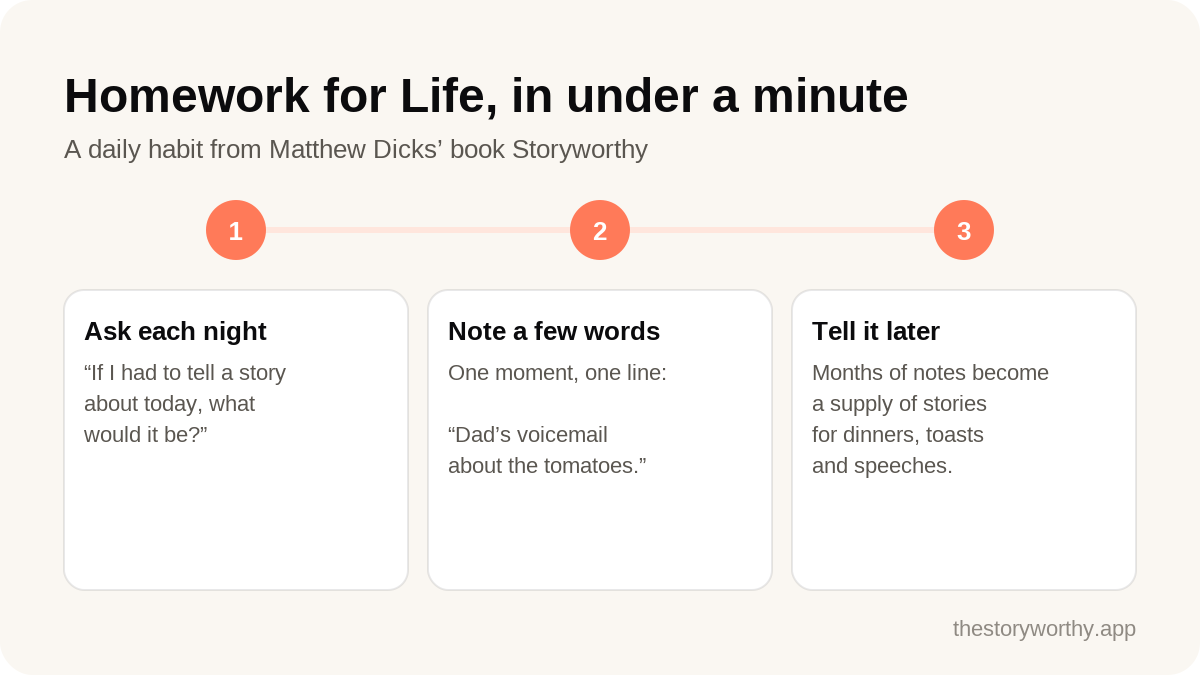
- Ask one question. “If I had to tell a story about today, what would it be?”
- Choose one moment. Not the biggest event; the one with a small shift in it.
- Write a few words. A short line that will bring the moment back: “Dad’s voicemail about the tomatoes.”
- Move on. Don’t write the story. The note is the whole assignment.
Why one moment a day is enough
It’s tempting to think a “real” journal means pages per day. Homework for Life asks for one line, and that’s exactly why it works.
- One line is too small to skip. You can do it on a bad day, a busy day, a day you’re sick.
- Choosing is the exercise. Asking “which moment was most story-worthy?” trains you to notice moments while they happen. Many people who keep the habit say they start seeing stories during the day, not just at night.
- The list compounds. A single entry is nothing. A year of entries is 365 moments you’d have lost.
- Your days stop blurring. Weeks that felt identical turn out to have had distinct moments in them.
Days without anything dramatic are the whole point. The skill is noticing the small moment on an ordinary Tuesday.
What counts as story-worthy
A story-worthy moment usually has some kind of change in it: you learned something, saw someone differently, felt something unexpected, or made a small decision. It doesn’t need to be big.
| Looks like nothing | Why it might be story-worthy | A few-word note |
|---|---|---|
| Your kid asked a question at dinner | It made you see something new | “Lily: do trees know they’re trees?” |
| A stranger held the elevator | You’d been having a terrible day | “Elevator man, ‘You look like you need this’” |
| You burned dinner | You laughed instead of getting mad | “Burnt lasagna, ordered pizza, laughed” |
| Your dad left a voicemail | You realized you’ll want to keep it | “Dad’s voicemail about the tomatoes” |
| You said no to a meeting | First time you’d done that | “Declined the 4pm. Nothing happened.” |
| You walked a different route | You noticed a house you’d never seen | “Blue door on Elm, the old man waving” |
Good signs a moment is worth noting:
- You felt a flash of something: embarrassment, pride, tenderness, surprise.
- You’d mention it to your partner or a friend.
- Something is a little different than it was this morning.
- A line someone said is still in your head.
A spreadsheet, a notebook or your voice
Dicks recommends a spreadsheet: one column for the date, one for the moment, a row per day. It’s searchable, it doesn’t run out of pages, and you can see years at a glance. But the format matters much less than doing it.
- Spreadsheet. Easy to search and scroll. Best if you’re at a computer every evening.
- Notebook. Good if you like paper and a bedside routine. Harder to search later.
- Notes app. Always with you. Use one long note with a date on each line.
- Your voice. Say the moment out loud in 15 to 30 seconds. Easiest when you’re tired or on the move, and a recording keeps more of the feeling. Pair it with a transcript so you can search it. Our guide to keeping an audio journal covers this in more detail.
If you’re stuck on what to note on a given day, a short list of journal prompts can help, but try the main question first. It works most nights.
From a note to a story you can tell
The note is a seed, not a story. When you want to turn one into something you can tell (at dinner, in a speech, on a date), go back to it and ask:
- Where did it start? Find the first moment of action.
- What did I want? Even something small: to get home, to not cry, to be liked.
- What changed? The turn in the moment.
- How was I different after? The ending.
Take “Burnt lasagna, ordered pizza, laughed.” The story might be: “I’d been trying to make my grandmother’s lasagna for my in-laws, the first time they’d come over. The smoke alarm went off as they rang the doorbell. My father-in-law, who I’d always found intimidating, opened the oven, looked inside, and said, ‘Well, this is the best night we’ve had in months.’ We ordered pizza. I stopped trying to impress him that night, and things got easier.”
That came from four words in a list. The full method for shaping it is in how to tell a story.
Keeping the habit going
Most people who drop Homework for Life don’t stop because it’s hard. They miss a few days and feel behind. Some ways to make it stick:
- Attach it to something fixed. Brushing your teeth, plugging in your phone, the last episode of the night.
- Set a reminder for the same time each evening.
- Never backfill more than a day. If you missed three days, start from today. The habit is the point, not a complete record.
- Count weeks, not days. “Five entries this week” is a good week.
- Read back once a month. This is the reward. Moments you’d forgotten come back, and you’ll find stories you didn’t know you had.
Homework for Life FAQ
Who created Homework for Life?
Matthew Dicks, a teacher, author and storyteller, describes Homework for Life in his book Storyworthy, published in 2018. He’s known for performing personal stories on stage and teaching storytelling. The habit is his, and the book is the best place to learn it in full.
Is the Storyworthy app connected to Matthew Dicks’ book?
No. The Storyworthy app, made by Atomicle Labs, shares a word with the book but isn’t affiliated with Matthew Dicks or his publisher. The app is a voice journal for your stories; the book is a guide to storytelling that we recommend reading.
Do I have to use a spreadsheet for Homework for Life?
No. A spreadsheet is what Dicks suggests because it’s searchable and compact, but a notebook, a notes app or a short voice recording all work. Pick the one you’ll actually use every night, and make sure you can find old entries later.
What if nothing story-worthy happened today?
Something almost always did; it was just small. Ask which moment you’d mention if a friend asked “How was your day?” A sentence someone said, a small decision or a moment of feeling something counts. Finding moments on ordinary days is the skill the habit builds.
Practice it with Storyworthy
If the voice version appeals to you, Storyworthy is built for it: you talk for about 30 seconds a day (or type), it writes your words down, and AI gives each story a title and tags it by emotion, the people in it and where it could be told. Daily reminders at your chosen time and a weekly streak help the habit hold, and a telling guide turns any note into a story you can tell. Again, we’re not connected to the book; we just think the habit is worth building.
The app isn’t in the stores yet. Join the waiting list to try it.