Gratitude Journal: How to Keep One That Doesn't Get Boring
How to keep a gratitude journal that stays fresh: write small specific moments instead of the same three lists, with prompts and a weekly rhythm.
A gratitude journal is a place where you regularly note things you’re thankful for. The version that lasts isn’t a list of “family, health, coffee” repeated every night. It’s one small, specific moment written as a mini story: who, where, what happened, and why it mattered. Below is how to start one, prompts that dig deeper than the usual list, how often to write, and why speaking your entries can make the habit easier.
What is a gratitude journal?
A gratitude journal is a notebook, app or recording where you write down things you’re grateful for, usually daily or a few times a week. It’s one of the most common gratitude practices because it’s simple and private. It works best when entries are specific moments (“Ana saved me a seat at the meeting”) rather than broad categories (“my friends”).
Writing about good experiences helps you notice and remember them, and many people find that a regular gratitude practice shifts their attention toward what’s going right. The catch is that the habit often fades within a few weeks. The reason is usually the format.
Why gratitude lists go stale
Most people start a gratitude journal with three bullet points a night. Within a couple of weeks, the lists look like this:
- My family
- My health
- Coffee
Those are real things to be grateful for. But writing them down for the fortieth time doesn’t make you feel anything, and reading them back tells you nothing about that day. The journal turns into a chore, and the chore gets skipped.
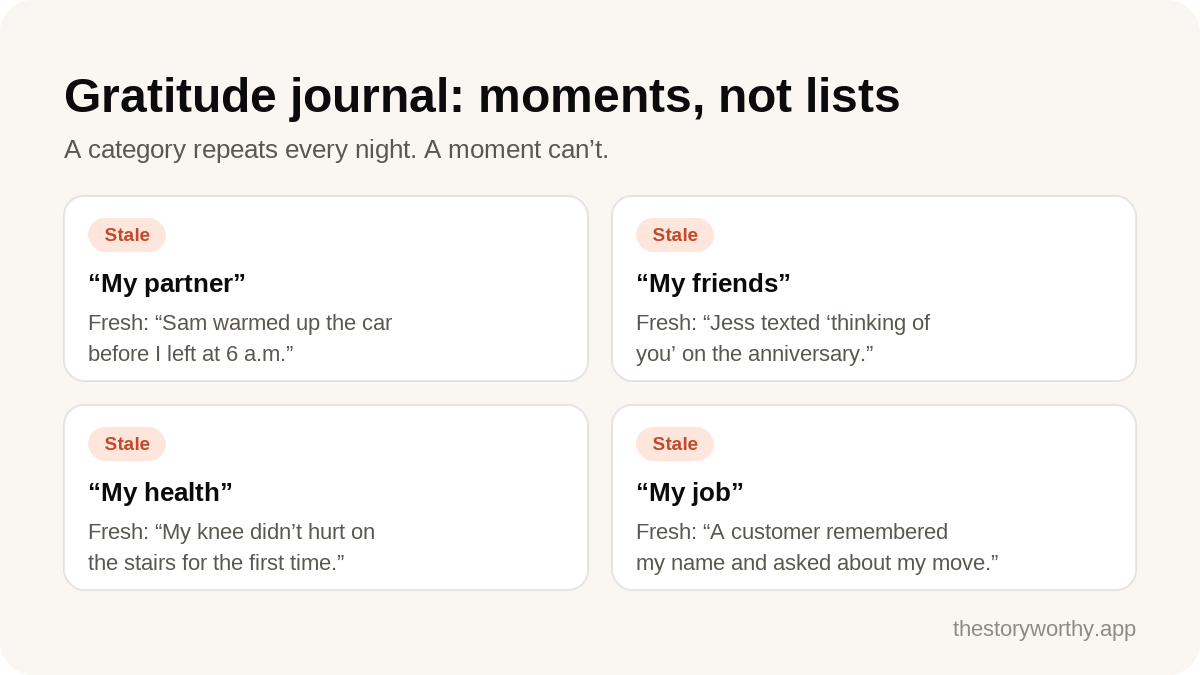
The problem is categories. “My family” is a category. “My son walked in while I was on a hard work call and silently put a cookie on my desk” is a moment. You can’t write the same moment twice, so the journal can’t go stale.
Write the moment, not the category
| Category (goes stale) | Moment (stays fresh) |
|---|---|
| My partner | “Sam warmed up the car before I left at 6 a.m.” |
| My health | “My knee didn’t hurt on the stairs for the first time since March.” |
| My friends | “Jess texted ‘thinking of you’ on the anniversary without me asking.” |
| My job | “A customer remembered my name and asked how my move went.” |
| Nature | “The fog sat on the river this morning like it was holding its breath.” |
| Food | “Grandma’s soup recipe actually tasted like hers this time.” |
How to start a gratitude journal in 5 steps
- Choose a format you’ll reach for. A small notebook by the bed, a notes app, or a voice recording.
- Pick one time. Right before bed or with your morning coffee. Same time every day.
- Write one moment, not three items. Who was there, what happened, and why it mattered.
- Keep it to two or three sentences. Short enough that you never dread it.
- Read back on Sundays. Five minutes with last week’s entries is where the habit pays off.
An example entry: “Tuesday, after the dentist. The receptionist saw I was rattled and said, ‘You did great, honestly.’ Small thing. It got me through the drive home.”
That’s three sentences. It has a time, a person, a line of dialogue and a feeling. Six months from now you’ll read it and remember that Tuesday.
Gratitude journal prompts that dig deeper
When “What am I grateful for today?” draws a blank, use a sharper prompt. Each one points you at a specific moment.
About people
- Who made today a little easier, even if they didn’t know it?
- What’s something someone said this week that I’m still thinking about?
- Who would I thank if I could send one text right now, and for what moment?
- When did someone notice something about me today?
About small things
- What did I see today that was beautiful for about three seconds?
- What worked today that usually doesn’t?
- What did I eat, drink or hear that I’d want to have again?
- What’s something I used today that someone else made with care?
About hard days
- What went wrong today, and who or what helped?
- What’s one thing that was better than I expected?
- What am I grateful I didn’t have to deal with today?
Looking back
- What’s a moment from this month I’d want to remember in ten years?
- Who did I take for granted a year ago that I appreciate now?
- What’s something I have now that I once hoped for?
For a longer list of starting points, see things to be grateful for. If you’d like prompts that go beyond gratitude into reflection, try these reflection questions or the broader set of journal prompts.
Daily or weekly: what works
There’s no rule. Some people prefer a daily entry because it trains them to look for good moments during the day. Others find daily entries turn mechanical and prefer a longer entry two or three times a week.
| Rhythm | Good for | Watch out for |
|---|---|---|
| Daily, one moment | Building the habit of noticing | Writing on autopilot |
| 3 times a week | Busy schedules, more depth per entry | Forgetting which days |
| Weekly review | Seeing the shape of your week | Losing small moments |
| Daily plus weekly review | Best of both | Takes a little more time |
A practical middle ground: one short moment most days, plus five minutes on Sunday reading the week back and starring your favorite.
Speaking your gratitude instead of writing it
If you’ve started and stopped a gratitude journal before, the problem may be the pen. Writing at the end of a long day takes energy you don’t have. Saying it out loud doesn’t.
Try recording a 30-second voice note instead:
“Today I’m grateful for the guy at the hardware store who spent ten minutes helping me find the right washer, and then said, ‘Come back and tell me if it worked.’ It made me feel like I’m part of a neighborhood.”
Spoken entries tend to be more natural and more detailed than written ones, and you can do them on a walk, in the car, or while making tea. The only downside is finding them again later, which a transcript solves. More on that in our guide to keeping an audio journal.
Looking back: the best part of the habit
The real payoff of a gratitude journal isn’t the writing. It’s the rereading.
On a hard day, reading a month of specific good moments is a reminder that the hard day isn’t the whole picture. At the end of the year, flipping back through hundreds of small moments shows you what your life was actually made of: mostly people, and mostly small kindnesses.
A few ways to make looking back easier:
- Put the date and a person’s name at the start of each entry.
- Star or tag your favorites as you go.
- Once a month, pick the best entry and tell that person what you wrote.
That last one is the most powerful thing you can do with a gratitude journal. A moment of gratitude, said out loud to the person, becomes a story you share.
Gratitude journal FAQ
What should I write in my gratitude journal?
Write one specific moment from your day that you’re grateful for, in two or three sentences: who was there, what happened, and why it mattered. Specific moments are easier to write, harder to repeat, and much more satisfying to reread than general lists like “family” or “health.”
How many things should I write in a gratitude journal?
One good moment is enough. The traditional three-items format works for some people, but it often turns into repeating the same categories. If you prefer three, make each one a different specific moment rather than a broad category.
Is it better to keep a gratitude journal in the morning or at night?
Either works; consistency matters more. At night, you’re reflecting on a day that just happened, so moments are fresh. In the morning, yesterday’s moments are still clear and it can set a good tone for the day. Pick the time you’ll keep.
Can I keep a gratitude journal on my phone?
Yes. A notes app, a journaling app or voice recordings all work. Phones are always with you, which makes it easy to capture a moment as it happens. Choose a tool that keeps entries private and lets you search or browse them later.
Keep your gratitude moments in Storyworthy
Storyworthy is a voice journal where each entry is a short story from your day, spoken in about 30 seconds or typed. It writes your words down, and AI tags each story by emotion (joy, love, pride, hope, nostalgia…) and the people in it, so you can later ask for “moments I was grateful for my sister” and find them. Daily reminders at the time you choose help the habit hold.
It’s not in the app stores yet. Join the waiting list.