Audio Journal: How to Keep a Voice Diary You'll Stick To
How to keep an audio journal you'll actually stick to: what to say in a 30-second entry, voice memos vs a voice journal app, transcripts and privacy.
An audio journal is a diary you speak instead of write. You record a short entry, usually under a minute, about something that happened, and keep the recordings (ideally with transcripts) so you can find them later. It’s easier to keep up than a written journal because talking is fast and you can do it while walking or commuting. Here’s how to set one up, what to say, and how to make it stick.
What is an audio journal?
An audio journal, also called a voice journal or audio diary, is a collection of short spoken recordings about your life. Each entry captures a moment, a thought or a story in your own voice. The best audio journals pair each recording with a written transcript, a date and a few tags, so old entries are searchable instead of lost in a long list of files.
Why speak instead of write
Writing in a journal asks a lot: a quiet place, a pen or keyboard, and the energy to turn thoughts into sentences. Speaking asks almost nothing. You already talk all day.
A few things change when you journal out loud:
- It’s faster. You can say in 30 seconds what would take five minutes to write.
- It fits dead time. A walk to the car, waiting for a kettle, the end of a commute.
- It sounds like you. Spoken entries keep your humor, your pauses and the way you tell things. Reading back a written entry, you hear your “writing voice.” Listening back to a voice entry, you hear yourself.
- It’s closer to telling. If you ever want to tell these stories to other people, practicing them out loud is a head start.
The trade-off is that audio is harder to skim. That’s what transcripts solve, which we’ll get to.
What to say in a 30-second entry
The biggest problem with voice journaling isn’t recording. It’s pressing the button and having no idea what to say, then rambling for four minutes about your to-do list.
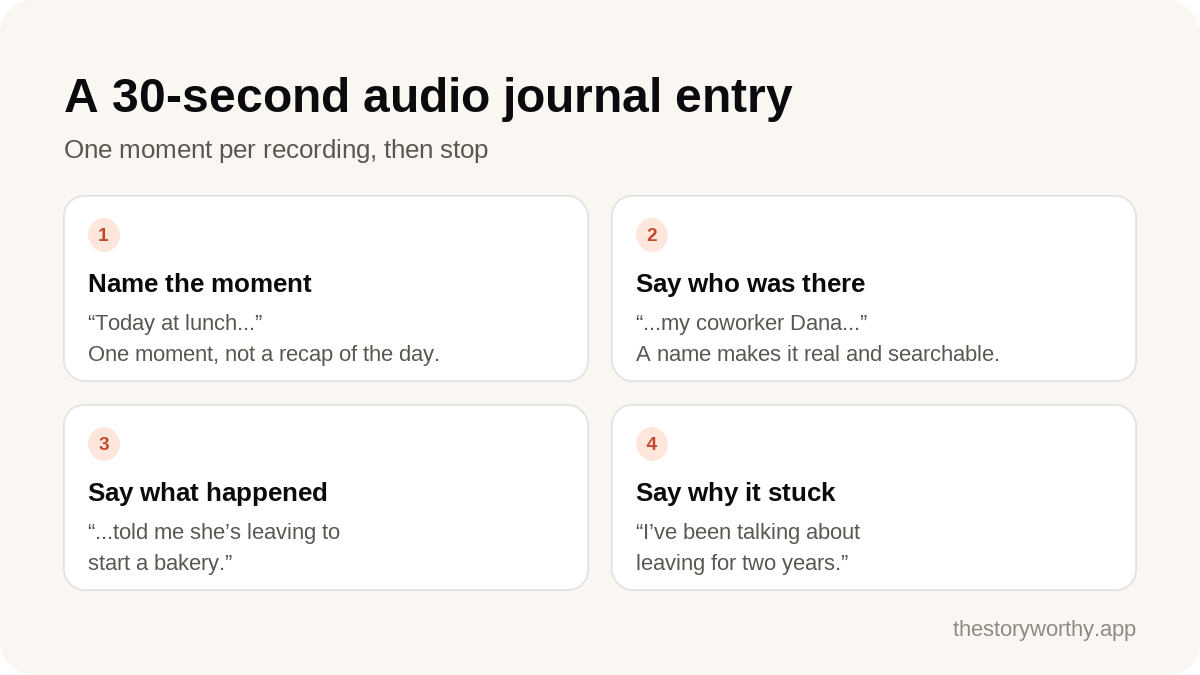
Give each entry a shape:
- Name the moment. “Today at lunch…” One specific moment, not a recap of the day.
- Say who was there. A name makes it findable and real.
- Say what happened. The action and, if there was one, the line someone said.
- Say why it stuck. One sentence on why you noticed it.
- Stop recording. Thirty seconds is plenty. Long entries are the ones you never replay.
Example: “Today at lunch, my coworker Dana told me she’s leaving to start a bakery. She said, ‘I’m 41 and I’m scared and I’m doing it anyway.’ I keep thinking about it because I’ve been talking about leaving for two years and haven’t done anything.”
That’s a complete entry. If you’re stuck for a moment to record, keep a list of journal prompts handy and answer one.
Voice memos vs a voice journal app
You can start an audio diary today with the voice memo app on your phone. Many people do, and it works fine for a few weeks. The problems show up later.
| Voice memos app | Voice journal app | |
|---|---|---|
| Cost | Free, built in | Often a subscription |
| Transcripts | Some apps offer them | Usually automatic |
| Finding old entries | Scroll by date or file name | Search, tags, titles |
| Prompts and reminders | None | Usually built in |
| Mixed with other audio | Yes, with meetings and songs | No, journal only |
If you go the voice memos route, a few habits help:
- Rename each recording right away with a short title: “Dana’s bakery.”
- Keep a separate folder just for journal entries.
- Once a week, note the best two or three titles in a text file so you can find them later.
If you find yourself skipping those steps (most people do), that’s the point where a dedicated app earns its place.
Transcripts: why you’ll want the words written down
Six months from now you won’t remember which day you recorded the story about Dana. You’ll remember “the bakery thing.” Without a transcript, you’d have to listen to dozens of recordings to find it. With one, you search for “bakery.”
Transcripts also let you:
- Skim a month in two minutes instead of listening for an hour.
- Pull a line into a speech or toast without retyping it.
- See patterns. Reading your entries back in text, you notice which people keep showing up and which feelings repeat.
Some phones transcribe as you speak. Others can transcribe a file afterward. Either way, check that the transcript is attached to the recording, not saved somewhere separate.
Privacy: where your recordings live
A voice diary is personal by nature. Before you commit to any tool, check:
- Where are recordings stored? On your phone only, in your cloud account, or on the app maker’s servers?
- Is AI used, and do you have to agree to it first? Transcription and tagging often use AI. You should be asked before your recordings are processed.
- Can you delete your data? Including your account and every recording in it.
- Is anything shared by default? A journal shouldn’t post anywhere.
Also think about where you record. Earbuds with a mic let you speak quietly on a walk. In shared homes, a parked car is a surprisingly good recording booth.
Make it daily: time, place, trigger
The habit sticks when it’s attached to something you already do. Pick one:
- After you lock the front door in the morning. Record on the walk to the car or the bus.
- When you sit down in the car after work, before you start the engine.
- While the coffee brews.
- Right after you brush your teeth at night.
Then set a reminder at that time for the first few weeks. Track the habit by the week rather than the day: “I recorded at least three times this week” survives a busy Tuesday better than a daily chain that breaks once and never restarts.
If you want a deeper version of this habit, the idea of noting one story-worthy moment every day, known as Homework for Life, pairs naturally with voice journaling. And if you’re new to journaling in any form, how to start journaling covers the first month.
Audio journal FAQ
Is an audio journal as good as a written journal?
For capturing moments, yes, and for many people it’s better because they actually keep doing it. Writing can help you slow down and think, so some people do both: quick voice entries daily and a longer written reflection once a week. A transcript gives you the written version anyway.
How long should a voice journal entry be?
Thirty seconds to two minutes. Short entries get recorded more often and replayed more often. If you have more to say about something, record a second entry rather than one long ramble, so each recording stays about one moment.
What’s the best way to keep a voice diary private?
Use a tool that stores recordings in your own account, asks before any AI processing, and lets you delete everything. Avoid apps that share or post by default. Record where you won’t be overheard, such as a parked car or a walk with earbuds.
Can I use my phone’s voice memos as an audio journal?
Yes. It’s free and fine for getting started. Rename each recording with a short title, keep journal entries in their own folder, and turn on transcription if your phone offers it. The weak spots are search and reminders, which dedicated apps handle better.
Keep your audio journal in Storyworthy
Storyworthy is a voice journal for the stories of your life. You talk for about 30 seconds a day (or type), it writes your words down, and AI gives each story a title and tags it by emotion and the people in it. You can search by asking, “the story about Dana’s bakery,” and it’s private: stories stay in your account, and AI processing happens only after you agree to it. Daily reminders at a time you choose and a weekly streak help the habit stick.
It’s not in the app stores yet. Join the waiting list to try it first.