Reflection Questions for Every Day, Week and Year
Self reflection questions for daily, weekly and year-end check-ins, how to answer them in two minutes, and how to read your answers back so you learn from them.
Reflection questions work best when they come on a rhythm: a few quick ones every day, a slightly deeper set each week, and a big look back at the end of the year. Below are self reflection questions for each, a way to answer them in about two minutes, and how to read your answers back so they actually change something.
What are reflection questions?
Reflection questions are prompts that help you look back on your experiences to understand what happened, how you felt and what you’d do differently. Good self reflection questions are specific and short, such as “What surprised me today?”, and work best answered regularly, daily or weekly, so patterns become visible over time.
Why reflection needs a rhythm
Reflecting once in a while feels good and changes little. You remember the dramatic moments and forget the rest. Patterns, like the meetings that always drain you or the friend you always feel better after seeing, only show up when you answer the same kinds of questions again and again.
A rhythm also keeps reflection small. Two minutes a day is easy to keep. A two-hour reckoning every January isn’t.
| Rhythm | Time | Number of questions | Main purpose |
|---|---|---|---|
| Daily | 2 minutes | 1–3 | Catch moments and feelings |
| Weekly | 10 minutes | 4–6 | Spot patterns, plan next week |
| Monthly | 20 minutes | 3–5 | Read back, adjust habits |
| Year-end | 1 hour | 10–15 | See the story of your year |
Daily reflection questions
Pick one to three. Rotate them, or use the same ones every night.
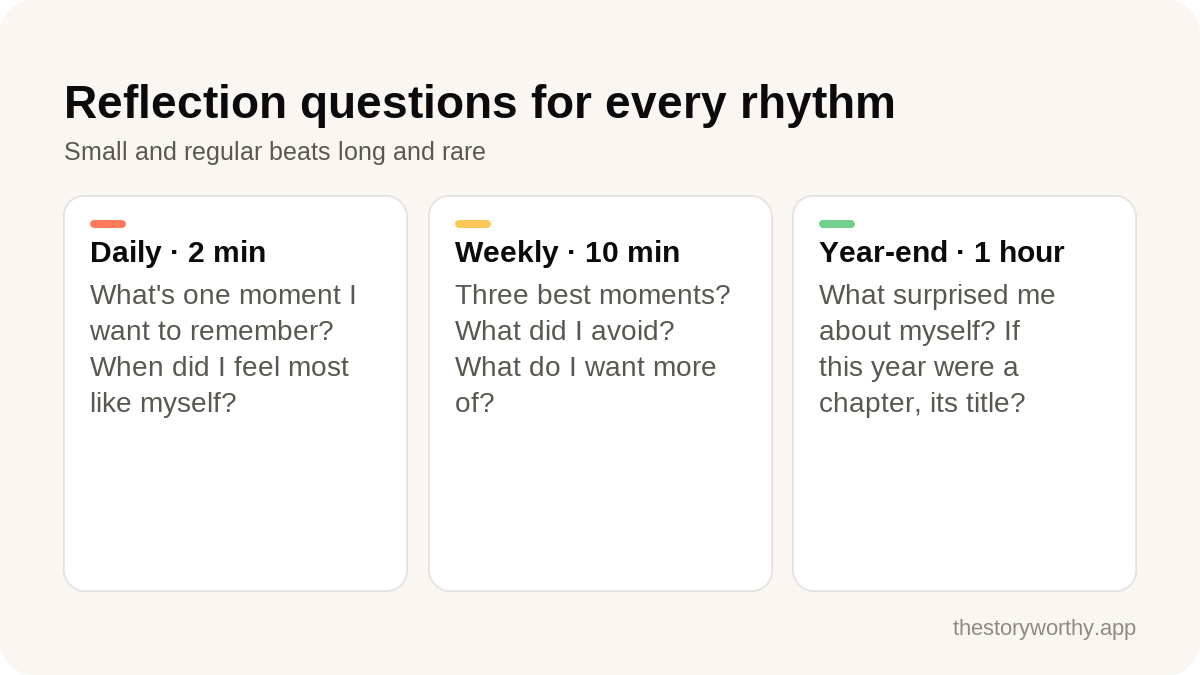
- What’s one moment from today I’d like to remember?
- What surprised me today?
- When did I feel most like myself?
- What drained my energy, and what gave me energy?
- What did I learn, even something small?
- Who did I enjoy talking to?
- What would I do differently if I had today again?
- What am I looking forward to tomorrow?
- What made me laugh?
- What’s one thing I did well?
The first question is the most useful over time. Feelings and lessons fade; specific moments carry them. “The moment my daughter read her first full sentence out loud” brings back the whole day.
Weekly reflection questions
A weekly reflection is where patterns start to show. Set a time, like Sunday evening or Friday after work.
- What were the three best moments of this week?
- What was harder than it needed to be?
- What did I avoid, and why?
- Who did I spend time with, and how did I feel afterward?
- What did I say yes to that I should have said no to?
- What progress did I make on something that matters to me?
- What’s one story from this week I’d tell a friend?
- What do I want more of next week? Less of?
Year-end reflection questions
Give these an hour in late December or early January. Look through photos, your calendar and your journal first; your memory alone will miss most of the year.
- What were the five best moments of the year?
- What was the hardest moment, and how did I get through it?
- Who mattered most to me this year?
- Who did I meet that I’m glad I met?
- What did I start that I’m proud of?
- What did I stop, and was it the right call?
- What surprised me about myself?
- What did I learn that I’ll keep?
- What story from this year will I still tell in ten years?
- If this year were a chapter, what would its title be?
- What do I want to carry into next year?
- What do I want to leave behind?
The chapter title question sounds silly and often gives the clearest answer. “The year I moved and found my people.” “The year everything was hard and I didn’t quit.”
Answering in 2 minutes
Most people quit reflective journaling because it feels like homework. Keep each answer small.
How to answer reflection questions in 2 minutes: 6 steps
- Choose the question before you sit down. Deciding is half the friction.
- Answer with a moment, not a summary. “Lunch with Sam, when she told me about the new job” instead of “Work was fine.”
- Write or say three sentences. What happened, how it felt, why it matters.
- Use your voice if writing feels slow. Speaking 30 seconds often says more than five minutes of writing.
- Skip the polish. Fragments are fine. No one is grading this.
- Stop at two minutes. Stopping while you still have more to say makes tomorrow easier.
For more journal prompts for self reflection, see journal prompts, and if this is your first time keeping any kind of journal, how to start journaling covers building the habit.
Read your answers back
Answers you never reread are like photos you never look at. Reading back is where reflection turns into insight.
- Once a month, read the last four weeks. It takes ten minutes.
- Look for repeats. The same person who gives you energy. The same task you avoid. The same time of day you feel low.
- Mark the stories. Some answers are moments worth telling: at dinner, in a toast, to your kids. Mark them so you can find them later.
- Pick one change. Not five. “Lunch with Sam every other week” or “No meetings before 10 on Fridays.”
Over a year, your answers become a record of what actually happened, not what you remember happening. That’s often kinder and more interesting than you’d expect. Many people find a gratitude angle helps here; the gratitude journal guide pairs well with weekly reflection.
Reflection questions: FAQ
What are good self reflection questions?
Good self reflection questions are specific and easy to answer honestly: “What’s one moment from today I want to remember?”, “What drained my energy?”, “When did I feel most like myself?”, “What would I do differently?” Avoid huge abstract questions like “Who am I?” for daily use; save bigger questions for year-end reflection.
How often should I do self reflection?
A couple of minutes daily and about ten minutes weekly is a sustainable rhythm for most people. Add a monthly read-back and a longer year-end reflection. Consistency matters more than length; short regular check-ins reveal patterns that occasional long sessions miss.
What is a weekly reflection?
A weekly reflection is a short review, usually 10 to 15 minutes at the end of the week, where you look at your best moments, what was hard, how you spent your time and energy, and what you want to change next week. It sits between quick daily notes and a big year-end review.
What’s the difference between reflective journaling and regular journaling?
Regular journaling often records what happened. Reflective journaling adds questions about why it happened, how you felt and what you learned. In practice the best journals mix both: record one specific moment, then answer one question about it.
Reflect out loud with Storyworthy
Storyworthy is a voice journal that makes the two-minute habit easy. A daily reminder comes at the time you choose; you talk for about 30 seconds, or type, and it writes the moment down, titles it and tags it by emotion and the people in it. A weekly streak keeps the rhythm going, and when you read back, you can search by asking: “times I felt proud this year.”
It isn’t in the app stores yet. Join the waiting list.