How to Start Journaling (and Keep Going Past Week Two)
How to start journaling as a beginner: pick a format, start with one moment a day, set a time and a reminder, and know what to do when you miss a day.
To start journaling, pick a format you’ll actually use (paper, an app or your voice), then write or say one moment from your day at the same time every day. Keep it to a few lines. That’s the whole beginner plan. Most people quit journaling because they start too big. This guide shows how to start small, what to write on day one, and how to recover when you miss a day, so you’re still journaling a month from now.
How do you start journaling as a beginner?
Start journaling by committing to something so small you can’t fail: one moment from your day, two or three sentences, at a set time. Choose paper, an app or voice recording based on what you’ll reach for most easily. Use a reminder for the first few weeks, and don’t worry about doing it “right.” There’s no right way.
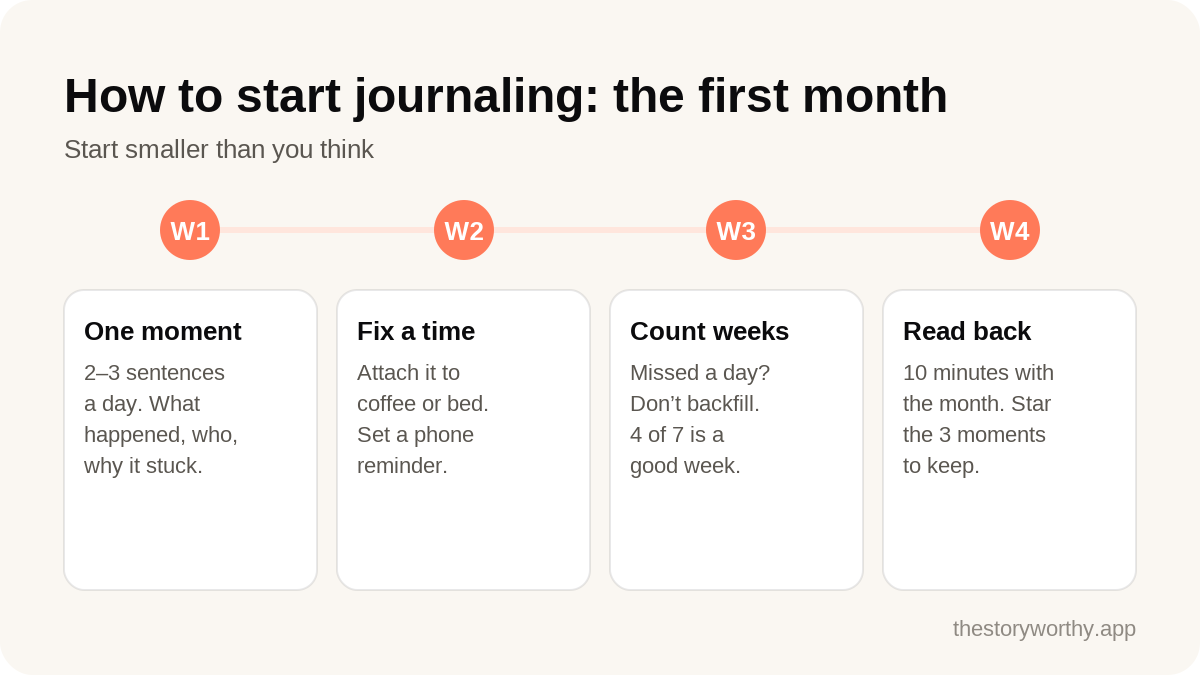
How to start journaling in 6 steps
- Pick your format. Paper, app or voice: whichever is easiest to grab.
- Choose a time. Attach it to something you already do every day.
- Set a reminder. Phone alarm or app notification, same time daily.
- Write one moment. What happened, who was there, why it stuck.
- Stop after a few lines. Leave yourself wanting to write more tomorrow.
- Read back after a month. This is the reward that keeps you going.
Pick your format: paper, app or voice
No format is better in general. The best one is the one with the least friction for you.
| Format | Best for | Downsides | Time per entry |
|---|---|---|---|
| Paper notebook | People who like writing by hand, screen breaks | Hard to search, easy to forget at home | 5–10 minutes |
| Notes or journal app | Typing fast, journaling anywhere | Notifications pull you away | 3–5 minutes |
| Voice journal | Busy people, commuters, people who think out loud | Need transcripts to find things later | 30 seconds–2 minutes |
| Mixed | Voice on weekdays, paper on weekends | Entries in two places | Varies |
If you’ve tried paper before and stopped, try voice. If you’ve tried apps and found them distracting, try a small notebook. The format that failed you last time is a clue. More on the voice option in our guide to keeping an audio journal.
Start smaller than you think
The classic beginner mistake is buying a beautiful notebook and planning to write a page every morning. Day one is great. Day four is a busy morning. By day ten, the notebook is on a shelf.
Start with one moment. Not a summary of the day, not your goals, not your feelings in general. One thing that happened. Something like:
- “Grabbed coffee with Marcus. He told me he’s finally quitting his job. He looked lighter than I’ve seen him in years.”
- “My daughter read a whole page out loud without stopping. She looked up at me after like she’d won a race.”
- “Got a parking ticket. Laughed about it, which surprised me.”
Two or three sentences. If you want to write more, write more. But “done” is one moment.
What to write on day one
The blank page is the hardest part. Here are a few beginner journal prompts that make the first entry easy:
- What’s one moment from today you’d tell a friend about?
- Who did you talk to today, and what did they say that stuck?
- What surprised you today, even a little?
- What made you laugh?
- What’s something you noticed that you usually walk past?
Pick one. Answer it in a few lines. That’s your first entry.
If you’d like a bigger supply, we have 120 journal prompts grouped by theme, and a list of journaling ideas for when you want to try something different.
Set a time and a reminder
A journal without a set time becomes something you’ll do “later,” and later doesn’t come. Tie it to something you already do every day:
- Morning: with your first coffee, before you check your phone.
- Commute: a voice entry on the walk to the bus or in the parked car.
- Lunch: five minutes after you eat.
- Evening: right after dinner, or when you get into bed.
Then set a phone reminder at that time. You won’t need it forever. After a few weeks, the habit runs on its own. But in the first month, the reminder is what gets you through the days you’re tired, busy or not in the mood.
What to do when you miss a day
You will miss a day. Everyone does. What matters is what happens next.
- Don’t backfill. Writing three entries to “catch up” turns journaling into homework. Just write today’s.
- Don’t restart the count. If you journaled five out of seven days, that’s a good week, not a failed one.
- Count weeks, not days. A weekly goal (“at least four entries this week”) survives a busy Tuesday. A daily streak breaks once and feels ruined.
- Shrink the entry. On a hard day, one sentence counts. “Rough day. Mom called, that helped.” is a real entry.
- Change the time if it keeps failing. If you miss your evening entries every week, the problem isn’t you, it’s the time slot.
Missing two weeks? Start again tomorrow with one moment. Nobody is grading this.
Read back after a month
The first month of journaling is mostly effort. The payoff starts when you read it back.
After about 30 days, sit down with your entries for ten minutes. You’ll notice:
- Moments you’d already forgotten, even from a few weeks ago.
- The people who keep showing up.
- What tends to make your days good, and what doesn’t.
- A few entries that are actually good stories you could tell someone.
Many people say this is the moment journaling clicks. You stop doing it because you should and start doing it because you want to keep the moments.
A good monthly ritual: read back, then star or mark the three entries you’d most like to remember. Over a year, you’ll have 36 moments that are the highlights of your life that year.
How to start journaling FAQ
What should I write in my journal as a beginner?
Write one moment from your day: what happened, who was there and why it stuck with you. Two or three sentences is enough. Moments are easier to write than feelings or goals, and they’re more interesting to read later. Use a simple prompt like “What surprised you today?” if you’re stuck.
How long should a journal entry be?
As long as it takes to capture one moment, usually two to five sentences or 30 seconds out loud. Short entries are easier to keep up, which matters more than length when you’re starting. On days you feel like writing more, write more.
Is it better to journal in the morning or at night?
Either works. Evening is good for capturing the day’s moments while they’re fresh. Morning works if you’re more alert then; just write about yesterday. Choose the time you can protect every day, and attach it to something you already do.
Do I need to journal every day?
No. Daily is a good target because it builds the habit, but four or five days a week is still a strong practice. Count weekly progress instead of a daily streak, and never feel you need to catch up on missed days.
Start with Storyworthy
If voice sounds like the easiest way in, Storyworthy is a voice journal built for beginners: you talk for about 30 seconds a day (or type), it writes your words down, and AI gives each entry a title and tags it by emotion and the people in it. It reminds you at the time you choose and tracks a weekly streak, so a missed Tuesday doesn’t sink the habit.
It’s not in the app stores yet. Join the waiting list.