Journaling Ideas: What to Write When You Don't Know
Journaling ideas for blank-page days: one-moment entries, lists, unsent letters, people portraits, firsts and lasts, and voice notes, with prompts to copy.
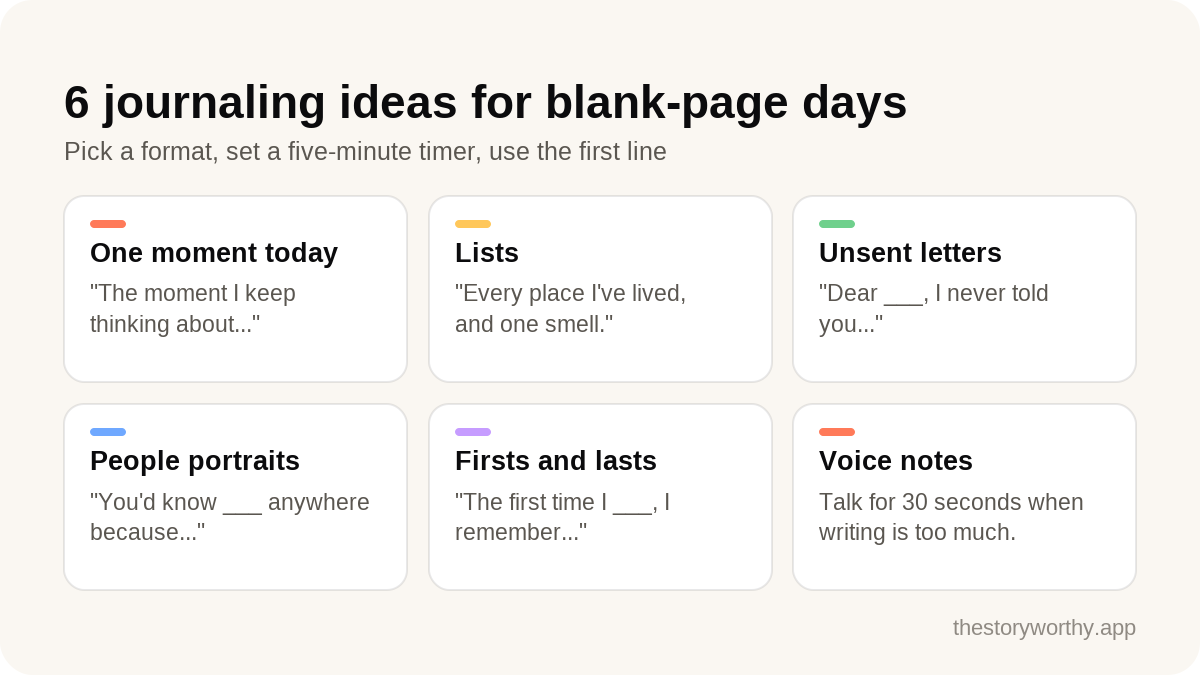
When you open your journal and nothing comes, you don’t need more motivation. You need a format. The journaling ideas below are shapes you can pour any day into: a single moment, a list, a letter you won’t send, a portrait of someone, a first or a last, or a voice note when writing feels like too much. Pick one, set a timer for five minutes, and start with the sample line.
What should I write in my journal?
Write about one specific moment from today: what happened, who was there, and why it stuck with you. If nothing comes, use a format instead of a topic, such as a list, a letter you won’t send, or a portrait of someone you saw. Short, concrete entries beat long summaries of the whole day.
The “one moment today” entry
Most blank pages come from trying to summarize a whole day. Days are big and mostly the same. Moments are small and different.
Ask: what’s one thing from today I’d still remember next week? It can be tiny.
- The cashier who sang along to the radio.
- The second your kid realized the ice cream had fallen off the cone.
- The email that made your stomach drop, then turned out to be fine.
Write it like a scene. Where were you? What did you see, hear, say? What did you feel right then? Stop when the moment ends. Five sentences is a full entry.
Start with: “The moment I keep thinking about from today is…”
This one format can carry a journal for years. If you want a list of questions to point you at moments, the journal prompts article has plenty.
Lists that turn into stories
Lists are the easiest thing to write when you’re tired. They also hide stories. A list item is a door; you only have to open one.
Fun list ideas:
- Every place I’ve lived, and one smell from each.
- Things I believed at 12 that turned out to be wrong.
- Meals I remember, and who I ate them with.
- Times a stranger was kind to me.
- Things I’m secretly good at.
- Every job I’ve had, and the strangest day in each.
Write the list fast, then circle the item that makes you smile or wince. Write three more sentences about that one. That’s how a list becomes an entry.
Start with: “Things I can still picture from my grandmother’s kitchen: …”
Letters you won’t send
A letter gives your writing someone to talk to, which makes it easier to say real things. Because you won’t send it, you can be honest.
Who to write to:
- Yourself, ten years ago, the night before something big.
- A friend you drifted away from.
- The teacher who changed your mind about something.
- Your future kid, about the week you’re having.
- Someone who annoyed you today (and you’re glad you didn’t reply to).
Keep it specific. “I’m grateful for you” says little. “I still think about the night you drove two hours because my car broke down” says everything.
Start with: “Dear ___, I never told you this, but…”
People portraits
Pick one person you saw today and describe them so someone else could picture them. Not a résumé: the way they laugh, what they always order, the phrase they repeat.
Portraits are good creative journal prompts because they train you to notice. They also become the most precious pages later, especially portraits of family.
Try these:
- Your partner in the five minutes after they wake up.
- A coworker in a meeting that’s running long.
- A grandparent telling the same story for the tenth time, and what changes each time.
- A stranger on the train, and the life you imagine for them.
Start with: “You’d know ___ anywhere because…”
Firsts and lasts
Firsts and lasts are where life’s stories live. You remember your first apartment and the last time you saw your childhood home.
Firsts:
- First time you felt like an adult.
- First time you got lost somewhere new.
- First time you said “I love you,” or heard it.
Lasts:
- The last day at a job.
- The last time you saw someone, if you’d known.
- The last time you did something you used to do every day.
Firsts and lasts also happen now, quietly. The first warm day of spring. The last time your kid asked you to carry them. Catching them as they happen is one of the best things a journal can do.
Start with: “The first time I ___, I remember…”
Journaling ideas compared
| Format | Time | Best for | Sample start |
|---|---|---|---|
| One moment today | 5 min | Daily habit | “The moment I keep thinking about…” |
| List | 3 min | Tired evenings | “Every place I’ve lived…” |
| Unsent letter | 10 min | Big feelings | “Dear ___, I never told you…” |
| People portrait | 5 min | Noticing others | “You’d know ___ anywhere because…” |
| Firsts and lasts | 5–10 min | Memories | “The first time I ___…” |
| Voice note | 1 min | No energy to write | “Okay, so today…” |
Talk it instead of writing it
Some nights, writing is the obstacle. Your hand is tired, your head is full, the page feels like homework. On those nights, talk.
Speaking a journal entry has a few advantages:
- It’s fast. You can say in 30 seconds what takes five minutes to write.
- It sounds like you. Spoken entries keep your phrasing and humor.
- You can do it anywhere. On a walk, in the car once parked, while the kettle boils.
Read more about this in audio journal. The catch with voice notes is that they pile up and nobody listens back to 200 untitled recordings. Having them written down and labeled is what makes them useful later.
How to use these journaling ideas in 7 steps
- Pick one format for the week. Don’t choose every night; decide once.
- Keep the journal where you’ll see it. Nightstand, kitchen counter, phone home screen.
- Set a five-minute timer. Stop when it rings, even mid-sentence.
- Write one moment, not the day. Small and specific beats big and vague.
- Use the sample start. Copy it word for word if you’re stuck.
- Skip without guilt. A missed day is just a missed day.
- Read back monthly. Mark the entries you’d want to tell someone.
If you’re just beginning, how to start journaling covers the habit side in more detail.
Journaling ideas: FAQ
What do you journal about when nothing happened?
Something always happened; it was just small. Write about one moment you’d still remember next week, describe one person you saw, or make a quick list like “things I noticed on the way home.” Ordinary days are worth recording because they’re the ones you forget fastest and miss most later.
How long should a journal entry be?
As long as it takes to capture one moment, usually five to ten sentences. Short entries you write every day are worth more than long ones you write once a month. If you’re tired, three lines or a 30-second voice note still counts.
What are fun journal prompts for adults?
Try “the strangest job I’ve ever had,” “a meal I still think about,” “a time I was completely wrong,” “the best advice a stranger gave me,” or “what my 12-year-old self would think of today.” Prompts that ask for a specific memory are more fun than ones that ask for opinions.
Is it okay to journal by talking instead of writing?
Yes. A spoken entry captures the same memory and often sounds more like you. The only thing to plan for is finding it later, so make sure recordings get a transcript or at least a title and date.
Turn your journaling ideas into stories you keep
Storyworthy is a voice journal for the moments worth telling. Talk for about 30 seconds (or type), and it writes the entry down, gives it a title and tags it by emotion and the people in it, so a year of small moments stays easy to find. Daily reminders at the time you choose and “dares”, small things to try that end in a story, help on blank-page days.
It isn’t in the app stores yet. Join the waiting list to try it first.