How to Keep a Conversation Going (Without Forcing It)
How to keep a conversation going on dates, at networking events and dinner parties: follow-up questions, short stories, threading topics and natural exits.
To keep a conversation going, follow up on what the other person just said instead of switching topics, give something back with a short story of your own, and connect new topics to earlier ones. When it goes quiet, go back to a thread you left open. These four moves work on dates, at networking events and around a dinner table, and none of them require you to be naturally chatty.
How do you keep a conversation going?
You keep a conversation going by asking follow-up questions about what the other person just said, sharing a short related story of your own, and linking new topics to earlier threads. Listen for details, like a place, a name or a feeling, and ask about those. Balance asking and sharing so it feels like a trade, not an interview.
Follow up, don’t switch
The most common reason conversations die: someone answers a question and the other person asks a brand-new, unrelated one.
“What do you do?” “I’m a nurse.” “Cool. Do you have any pets?”
The nurse answer had a dozen doors in it. Switching topics closes all of them. Following up opens one:
“A nurse. What kind?” “Pediatric ICU.” “Wow. What’s a good day like there?”
Now they’re telling you something real. Good follow-ups ask about:
- A detail. “Wait, you said you lived in Portland?”
- A feeling. “Was that scary?”
- What happened next. “So did you take the job?”
- The why. “What made you pick that?”
- The best or worst. “What’s the best part of that?”
| They say | Weak response | Strong follow-up |
|---|---|---|
| “I just got back from Mexico.” | “Nice.” | “Where did you go? What was the best thing you ate?” |
| “I’m an accountant.” | “Cool.” | “Do you like it, or is it a means to an end?” |
| “I’m training for a half marathon.” | “I could never.” | “What got you into running?” |
| “Work’s been crazy.” | “Same.” | “Crazy busy or crazy weird?” |
| “I grew up in a small town.” | “Oh, okay.” | “What did people do on Friday nights?” |
Share a story to give them something back
Questions alone make a conversation feel like an interview. People open up more when you share too. The best thing to share is a short story, not a fact.
After they tell you about their trip to Mexico, don’t just ask another question. Give something back:
“That reminds me, the only time I went to Mexico City I got completely lost trying to find a taco place everyone recommended. A grandmother selling flowers walked me three blocks to it. Best tacos of my life.”
Then hand it back: “Did you get to Mexico City?”
Keep shared stories under a minute and connected to what they said. The goal is to show who you are and give them something to respond to. If you never seem to have a story ready, how to be a good storyteller explains how to build up a supply.
Thread topics
Threading means linking the conversation back to things said earlier. It’s one of the most useful conversation skills and one of the least used.
- “You mentioned your sister’s a chef earlier. Did she cook a lot growing up?”
- “Going back to the half marathon: what’s the longest you’ve run?”
- “That’s like what you said about your old job.”
Threading does two things. It shows you were really listening, which people notice and appreciate. And it gives you a reserve of topics so you never have to invent one from nothing.
A simple habit: as someone talks, mentally note two or three details you didn’t ask about yet. Those are your threads for later.
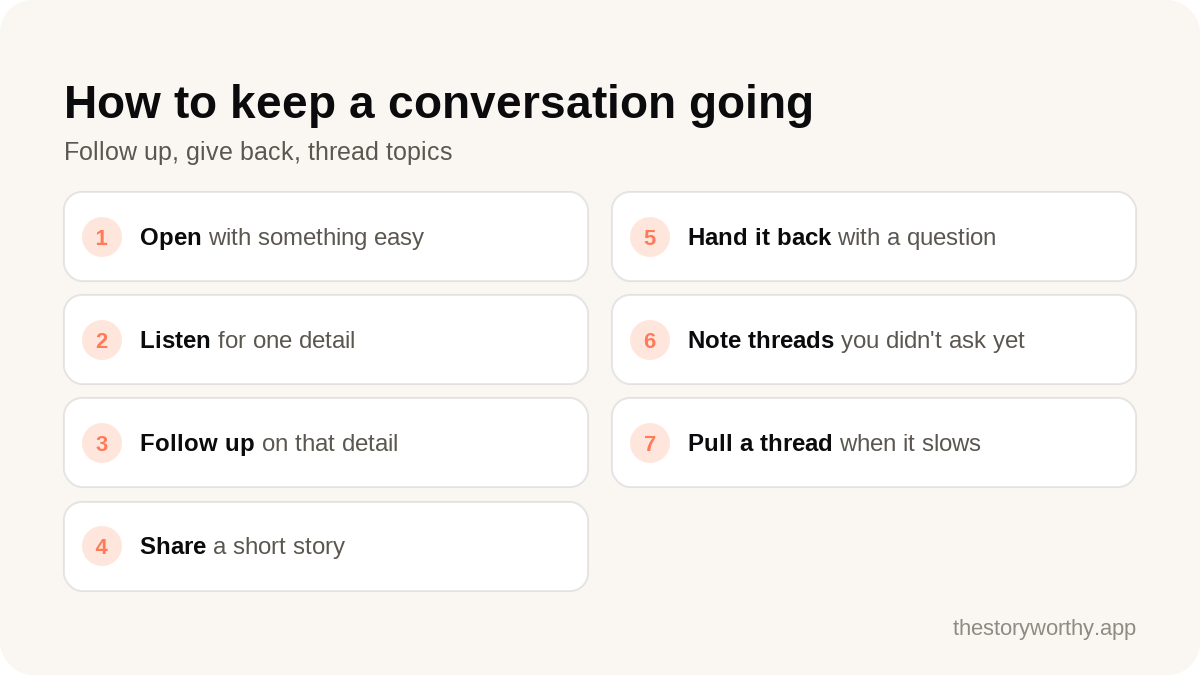
How to keep a conversation going in 7 steps
- Open with something easy. The setting, the event, how they know the host.
- Listen for one detail. A place, a name, a feeling, something unusual.
- Follow up on it. Ask about the detail rather than starting a new topic.
- Share a short related story. Under a minute, then stop.
- Hand it back. End with a question or leave space for them.
- Note threads as you go. Keep two or three unasked details in mind.
- Use a thread when it slows. “Going back to what you said about…”
When it goes quiet
Every conversation has lulls. A few seconds of silence is normal, not a failure. If it stretches, try one of these:
- Pull a thread. “Wait, you never told me how the Portland move happened.”
- Use your surroundings. “Have you tried the dumplings? I’ve had four.”
- Ask for a recommendation. “What’s the best thing you’ve watched lately?” People enjoy recommending things.
- Ask about something coming up. “Anything fun this weekend?”
- Tell a quick story. “Something weird happened on my way here…”
Conversation starters for a fresh start, if you need them:
- “What’s been the highlight of your week?”
- “What are you looking forward to right now?”
- “How do you know [host]?”
- “What’s keeping you busy outside work?”
- “Have you been to one of these before?”
For dates specifically, first date questions and what to talk about on a first date have more.
Exits that feel natural
Knowing how to end a conversation well is part of keeping conversations going: you’re more relaxed starting one when you know you can leave gracefully.
- Refer back to something good. “I’m going to go find those dumplings you mentioned. Really nice talking to you.”
- Introduce them to someone. “Have you met Priya? She’s also a runner.”
- Be honest and warm. “I promised I’d say hi to a few people, but I’m so glad we talked.”
- Make a plan if you mean it. “Let’s actually get that coffee. Can I get your number?”
End on something specific from the conversation. It tells them you were listening to the very end.
Practice in low-stakes places
You don’t have to practice on dates or at big networking events. Small, everyday conversations work just as well:
- The barista or the person at the deli counter
- A coworker you usually only say hi to
- A neighbor
- Someone next to you in a waiting room
- Relatives at a family dinner
Try one move at a time. This week, follow up instead of switching. Next week, share one short story. The week after, practice threading. Within a month, these become habits.
How to be interesting, it turns out, is mostly about being interested, plus having a few real stories to give back.
How to keep a conversation going: FAQ
How do you keep a conversation going over text?
The same rules apply. Respond to a detail in their message instead of changing the subject, add something of your own, such as a short story, a photo or an opinion, and end with an easy question. Avoid one-word replies like “lol” or “nice” that leave them nothing to work with.
What do you talk about when you have nothing to talk about?
Go back to something they said earlier, comment on your surroundings, ask for a recommendation or share something small that happened to you today. Everyday moments make good topics because everyone can relate. You rarely have nothing to say; you just haven’t noticed the threads available.
How do I stop a conversation from feeling like an interview?
Balance questions with sharing. After they answer, give something back: a related story or your own opinion, before asking anything else. Follow up on their answers rather than moving down a list of questions. A good conversation feels like trading, not questioning.
What are good conversation starters?
Questions about the present moment work best: “How do you know the host?”, “What’s been the highlight of your week?”, “What are you looking forward to?” They’re easy to answer and usually lead to stories. Avoid starters that invite one-word answers, like “Busy week?”
Have a story ready to give back
Storyworthy is a voice journal for the stories of your life. Talk for about 30 seconds a day and it writes the moment down and tags it, including where it fits, such as a first date or a dinner party. Before you head out, ask it for “something funny that happened this month” and you’ll have a story ready to share.
It isn’t in the app stores yet. Join the waiting list.